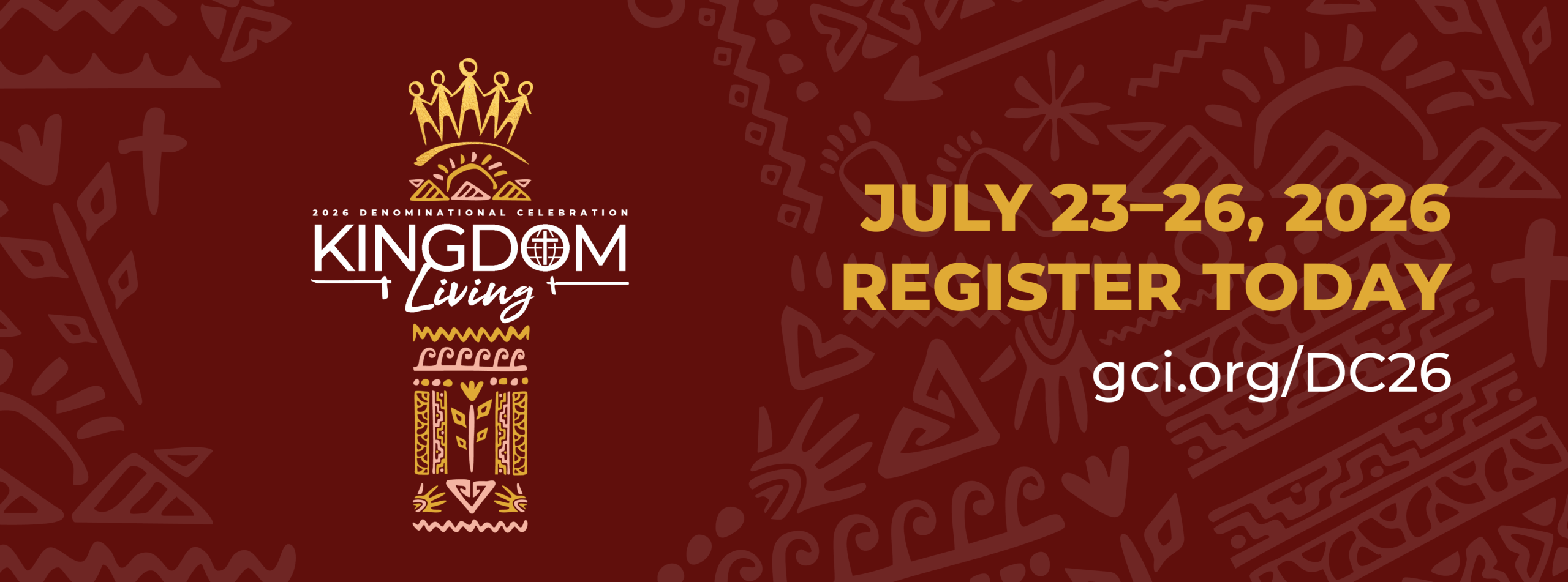
The Denominational Celebration will be held in Dallas, Texas, U.S. on July 23-26, 2026.
Kingdom Living is participatory, relational, and missional.
Jesus said, “As the Father has sent me, I am sending you.” As citizens of the kingdom and co-laborers with Christ, we are sent into the world to reflect his light. Kingdom Living requires awareness of our calling and our context, seeing our neighborhoods, vocations, and even our sufferings as places where Jesus reigns and sends us.
Kingdom Living is not passive. It is a bold proclamation and a tangible demonstration. We not only speak of the reign of God, but we also show it. Our words align with our works. As image bearers, our relationships become a visible witness to the reality of the kingdom being ushered in.
During this gathering, we’ll explore what it means to live as kingdom people, active participants in God’s mission, deeply rooted in community, and shaped by the presence and authority of Jesus.
“The reality is, my prayers don’t change God. But, I am convinced prayer changes me. Praying boldly boots me out of that stale place of religious habit into authentic connection with God Himself.” — Lysa TerKeurst
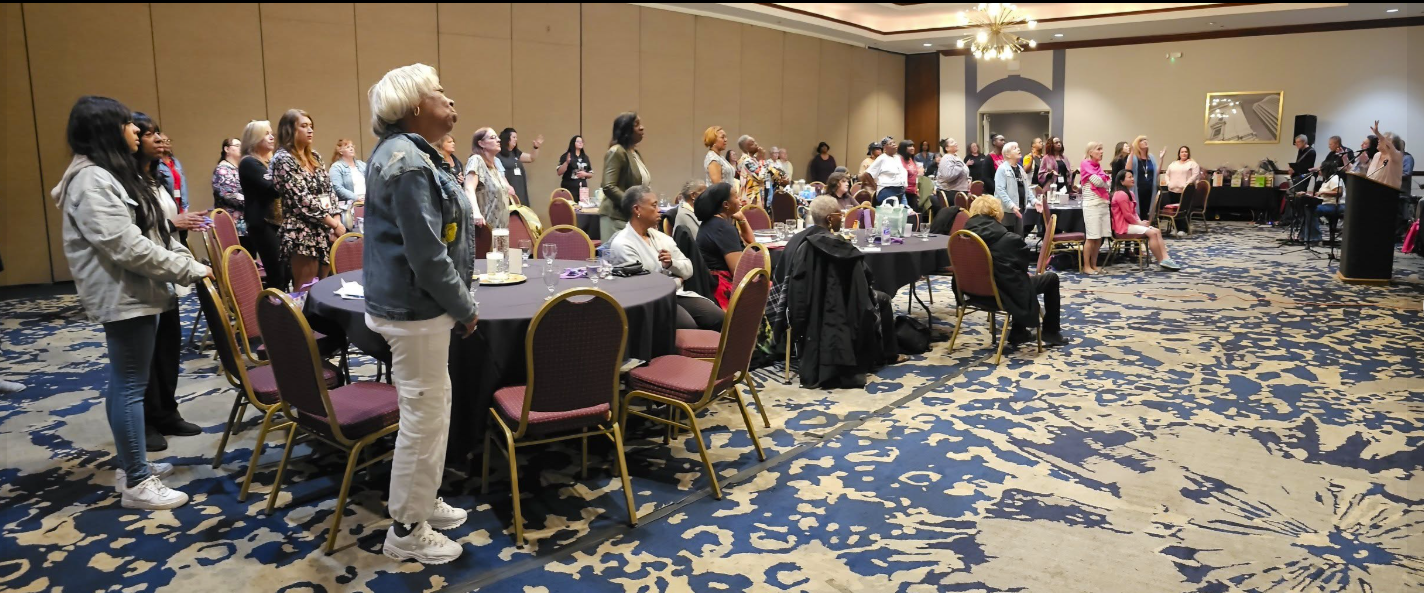
Let us join together in prayer as Christ’s Body. We lift our prayers, knowing the Spirit intercedes on our behalf.
The Denominational Celebration will be held in Dallas, Texas, U.S. on July 23-26, 2026.
Kingdom Living is participatory, relational, and missional.
Jesus said, “As the Father has sent me, I am sending you.” As citizens of the kingdom and co-laborers with Christ, we are sent into the world to reflect his light. Kingdom Living requires awareness of our calling and our context, seeing our neighborhoods, vocations, and even our sufferings as places where Jesus reigns and sends us.
Kingdom Living is not passive. it is a bold proclamation and a tangible demonstration. We not only speak of the reign of God, we show it. Our words align with our works. As image bearers, our relationships become a visible witness to the reality of the kingdom being ushered in.
During this gathering, we’ll explore what it means to live as kingdom people, active participants in God’s mission, deeply rooted in community, and shaped by the presence and authority of Jesus.
By Cara Garrity, Development Coordinator Lynn, Massachusetts, US
The kingdom of God is like …
When you consider the kingdom of God, what do you imagine it is like? What images come to mind? What hopes?
In the Gospels, we are gifted with several accounts of Jesus talking about the kingdom of God. In Mark 4, we find one such parable that Jesus shares.
Again he said, “What shall we say the kingdom of God is like, or what parable shall we use to describe it? It is like a mustard seed, which is the smallest of all seeds on earth. Yet when planted, it grows and becomes the largest of all garden plants, with such big branches that the birds can perch in its shade.” Mark 4:4:30–31 NIV
The kingdom of God is like … a mustard seed?
Here, Jesus is speaking in a parable. Parables are thought-provoking invitations to new insights. They are a dynamic, transformative, storytelling style of teaching. In more current terms, think less instruction manual and more Aesop’s Fables.
So, what can a mustard seed teach us about the kingdom of God?
What would the original hearers of this parable have known about the mustard seed and plant? Mustard seeds are exceedingly small seeds, yet they grow into very large plants. Mustard plants were considered weeds. They were not seeds that were intentionally planted but would grow wild in the mountainside. They certainly would not be planted in any curated garden. The mustard plant is invasive, uprooting any plants growing around it. The mustard plant grows uncontrollably, taking over the space, from a small seed to a large plant.
How might this image of the kingdom challenge our hopes and expectations for the kingdom? For the original hearers of this parable, the image of the mustard seed likely challenged their hope and expectation for the kingdom of God to bring a militaristic victory for the Jewish people over Rome. Their hopes were for a kingdom that was grand, majestic, powerful, and victorious. And instead, Jesus says the kingdom of God is like a mustard seed — an invasive weed. Powerful and disruptive in its own way, but not in the way the people had expected.
What expectations do you hold about the kingdom of God that are challenged by the image of a kingdom like a mustard seed? Personally, in agricultural terms, I would expect the kingdom of God to be more like a finely curated garden. Perfect. Predictable. Controlled. And yet, we are told the kingdom of God is like a mustard seed. Wild. Unpredictable. Invasive. Persistent. Maybe the kingdom of God is not “perfect” in the ways that I had imagined. Maybe the kingdom of God is not predictable and controllable in human terms. Maybe it is like the mustard seed.
What else does this image offer to us? The kingdom of God is reliable and dependable in its growth. The nature of the kingdom is to grow; it doesn’t need to be begged, coaxed, or convinced. It is not our responsibility to expand the kingdom of God. It is the nature of the kingdom to expand. Like the mustard seed, a “little bit can go a long way.”
The kingdom of God may appear in ways that are unexpected, or even undesired. It may grow in ways that uproot our finely curated plans. It may expand into places we never thought possible. The Kingdom is invasive; it can grow anywhere. We can expect the kingdom to be near in unexpected places.
The kingdom of God is near. It has been unleashed in our midst, and it cannot be tamed. It is tenacious, it is alive, it is self-determined, dynamic, and ever expanding. We can rest assured that the kingdom of God is like a strong plant that cannot be deterred in its growth.
Holy Spirit, draw us into greater awareness of the presence and growth of the kingdom around us. Attune us to the unexpected ways the kingdom shows up. Challenge our own hopes and desires for the kingdom and replace them with your vision. Show us what your kingdom is like. Amen.
The Denominational Celebration will be held in Dallas, Texas, U.S. on July 23-26, 2026.
Kingdom Living is participatory, relational, and missional.
Jesus said, “As the Father has sent me, I am sending you.” As citizens of the kingdom and co-laborers with Christ, we are sent into the world to reflect his light. Kingdom Living requires awareness of our calling and our context, seeing our neighborhoods, vocations, and even our sufferings as places where Jesus reigns and sends us.
Kingdom Living is not passive. it is a bold proclamation and a tangible demonstration. We not only speak of the reign of God, we show it. Our words align with our works. As image bearers, our relationships become a visible witness to the reality of the kingdom being ushered in.
During this gathering, we’ll explore what it means to live as kingdom people, active participants in God’s mission, deeply rooted in community, and shaped by the presence and authority of Jesus.
“Rejoice always, pray without ceasing, give thanks in all circumstances; for this is the will of God in Christ Jesus for you.” 1 Thessalonians 5:16-18
Let us pray continuously and joyfully as a united fellowship. Download the August prayer guide and pray with us as we celebrate and intercede how the Spirit is moving through GCI.
The Denominational Celebration will be held in Dallas, Texas, U.S. on July 23-26, 2026.
Kingdom Living is participatory, relational, and missional.
Jesus said, “As the Father has sent me, I am sending you.” As citizens of the kingdom and co-laborers with Christ, we are sent into the world to reflect his light. Kingdom Living requires awareness of our calling and our context, seeing our neighborhoods, vocations, and even our sufferings as places where Jesus reigns and sends us.
Kingdom Living is not passive. it is a bold proclamation and a tangible demonstration. We not only speak of the reign of God, we show it. Our words align with our works. As image bearers, our relationships become a visible witness to the reality of the kingdom being ushered in.
During this gathering, we’ll explore what it means to live as kingdom people, active participants in God’s mission, deeply rooted in community, and shaped by the presence and authority of Jesus.
By Al Kurzawa, Pastor Morwell and Seaford, Victoria, Australia
Did God leave us anything to do?
Have you ever volunteered and shown up to the job ready with gloves and tools in hand, only to find out that the work was already completed? You’ve set aside time to help only to be told to relax because everything is already done. The parable of the weeds (Matthew 13:24–30) and Jesus’ explanation of the parable (verses 36–43) can leave us feeling this way after our first read through. A quick recap shows who does all the action in this parable and it’s not us. We find Jesus has already sown the good seeds, the enemy has sown the weeds, the servants ask a couple of questions, and in the end the harvesters (the angels) collect the weeds at harvest and burn them. If we assume we are the good seeds, the people of the kingdom, we are left with only two passive things to do: shine like the sun and whoever has ears, let them hear. I guess we all got dressed up in our overalls for nothing!
In most of Jesus’ parables, there is an “aha!” moment after we have spent some time wrestling with it. Following some rough-and-tumble grappling, we find in this parable both the good news of the kingdom and a formidable and challenging opportunity for us as citizens of that kingdom. The good news is that the Son of Man has sown the good seed, and he has sown that good seed throughout the entire world.
Between the parable of the weeds and its explanation are the parables of the mustard seed and yeast that clue us in that the kingdom can seem small and hidden, but it is always growing and permeating the entire world. This is a good reminder that it is not for us to judge or decide who is or is not a citizen of the kingdom. The wheat and weeds are so similar and intertwined that we can do much damage if we try to make those judgements when God has told us he is the one that will take care of the sifting. We are to serve all our neighbors, all those we encounter, as good seed that has been sown by God. All humans are made in the image of God.
Even though most of the action seems to have been performed by others in this parable, the Son of Man does give us something to do. And this action is a lot tougher than it first appears. The man tells his servants, “Let both grow together until the harvest.” Let’s geek out on the Greek for a minute. The word “let” in this passage in the Greek can mean permit, suffer, let, or forgive.[i] Let them grow together or possibly suffer together. How does it challenge us when we think of it as “suffer together?” Is this the call to action in this parable for us as citizens? If we love our neighbor as our self, if we love one another as Jesus loved us, if we pray for our enemies, if we live as the beloved children of God, then at times we will experience suffering in this lifetime.
We may be experiencing suffering right now. When we open ourselves up to serving others, caring for others’ needs, loving others, then we also allow ourselves to be vulnerable and open to suffering. Here we were thinking all the hard work was done with the seeds already being planted and the angels taking care of the harvest! But we find in this simple term, “let, permit, suffer together,” our calling and challenge as citizens of the kingdom as we participate in Jesus’ mission to the world by serving those around us.
We are comforted knowing the kingdom will reach its fullness and the harvest will come. Jesus assures us that through our suffering and our participation in his plan of “let them grow together,” God is at work in mysterious ways that only he can accomplish. Our acts of service and our shared suffering for the kingdom will be transformed into moments of glory that will shine like the sun in the fullness of the kingdom. He who has ears, let him hear.
[i] William D. Mounce, Mounce Concise Greek-English Dictionary of the New Testament. Accordance electronic edition, version 4.6. Altamonte Springs: OakTree Software, 2011. See also Robert Farrar Capon, Parables of Kingdom, Grace, and Judgement. (Grand Rapids, MI: William B. Eerdmans Publishing Company), 90ff.
“Prayers outlive the lives of those who uttered them; outlive a generation, outlive an age, outlive a world.” — E.M. Bounds
Halfway through 2025, we pause to give thanks and seek God for what’s ahead. The July Prayer Guide helps you reflect, intercede, and stay connected to what God is doing across our church family.