GCI Update
Connecting Members & Friends of GCI
Header Banner

SE Asia Leaders’ Gathering


For three days in late April, the Southeast Asia Leaders Conference was successfully hosted by GCI Malaysia. The participants were pastors and church leaders from the Philippines, Thailand, Myanmar, and Malaysia. Asia Superintendent, Dan Zachariah and his wife, Mary, also attended.

The following topics were covered:

      • Fundamentals of Incarnational Trinitarian Theology by Aron Tolentino (Philippines).
      • Kingdom Culture and Kingdom Living by Devaraj Ramoo (Malaysia).
      • Theology of Healthy Relationships and Harmony in the Church by Dan Zachariah (India).
      • Development of GCI Asia towards Healthy Church (part 1) by Audie Santibañez (Philippines).
      • Development of GCI Asia towards Healthy Church (part 2) by Rex dela Peña (Philippines).
      • Development of GCI Asia towards Healthy Church (part 3) by Tim Andrew Rota (Philippines).
      • Nurturing Upcoming Leaders by Dan Zachariah (India).


One of the highlights of the conference was the lively interaction. Participants were actively engaged, and individual opinions and comments were a great benefit. The conference also had breakout groups that discussed the finer points of the topics that were presented. The participants enjoyed relaxing activities and dinner in the evenings.

On the Sunday, all the conference participants attended Sunday church service at the Klang congregation. Pastor Joselito Olaguer of Thailand and Pastor Chan Thleng of Myanmar gave split sermons.


It was very uplifting to see the grace and Kingdom Culture so vividly displayed among the members of the church. The presence of the Holy Spirit was so evident on all the days of the conference.

By Devaraj Ramoo, Pastor
Klang, Selangor, Malaysia


Kingdom Citizens’ Toolbox—Worship the Holy Spirit

Citizens of the kingdom believe the biblical evidence that the Holy Spirit is God in the same way that the Father is God and the Son is God. Scripture indicates that the Holy Spirit has divine attributes and works and is spoken of in the same way that the Father and Son are. The Holy Spirit is intelligent and speaks and acts like a divine Person. This is part of the scriptural evidence that led early Christians to formulate the doctrine of the Trinity.

We invite you to read an excerpt from “The Deity of the Holy Spirit” Read the full article here.


Christianity has traditionally taught that the Holy Spirit is the third Person or Hypostasis of the Godhead. Some, however, have taught that the Holy Spirit is an impersonal force used by God. Is the Holy Spirit God, or simply a power of God? Let’s examine the biblical teachings.

The deity of the Holy Spirit

Summary: Scripture speaks repeatedly of the Holy Spirit, known also as the Spirit of God and the Spirit of Jesus Christ. Scripture indicates that the Holy Spirit is of the same essence as the Father and the Son. The Holy Spirit is ascribed with the attributes of God, is equated with God and does work that only God does.

Attributes of God
      1. Holiness: In more than 90 places, the Bible calls the Spirit of God “the Holy Spirit.” Holiness is a basic characteristic of the Spirit. The Spirit is so holy that blasphemy against the Spirit cannot be forgiven, although blasphemy against Jesus could be (Matthew 12:32). Insulting the Spirit is just as sinful as trampling the Son of God under foot (Hebrews 10:29). This indicates that the Spirit is inherently holy, holy in essence, rather than having an assigned or secondary holiness such as the temple had. The Spirit also has the infinite attributes of God: unlimited in time, space, power and knowledge.
      2. Eternality: The Holy Spirit, the Counselor, will be with us “forever” (John 14:16). The Spirit is “eternal” (Hebrews 9:14).
      3. Omnipresence: David, praising God’s greatness, asked, “Where can I go from your Spirit? Where can I flee from your presence? If I go up to the heavens, you are there; if I make my bed in the depths, you are there” (Psalm 139:7-8). God’s Spirit, which David uses as a synonym for the presence of God, is in heaven and in sheol (verse 8), in the east and in the west (verse 9). God’s Spirit can be said to be poured out on someone, to fill a person, or to descend — yet without implying that the Spirit has moved away from or vacated some other place. Thomas Oden observes that “such statements are grounded in the premises of omnipresence and eternality — attributes ascribed properly only to God” (Life in the Spirit, page 18).
      4. Omnipotence: The works that God does, such as creation, are also ascribed to the Holy Spirit (Job 33:4; Psalm 104:30). Miracles of Jesus Christ were done “by the Spirit” (Matthew 12:28). In Paul’s ministry, the work that “Christ has accomplished” was done “through the power of the Spirit” (Romans 15:18-19).
      5. Omniscience: “The Spirit searches all things, even the deep things of God” (1 Corinthians 2:10). The Spirit of God “knows the thoughts of God” (verse 11). The Spirit therefore knows all things and is able to teach all things (John 14:26).

Holiness, eternality, omnipresence, omni­potence and omniscience are attributes of God’s essence, that is, characteristic of the nature of divine existence. The Holy Spirit has the basic attributes of God.

By Michael Morrison, GCS President
Glendora, CA, US

Kingdom Living—Testifying of God


Transcript

Hello! Or Bula! as we say in Fiji.

To share my story, I learned to live on my own when I was just 14. That was the year I left home to attend boarding school for high school. And with that, I stepped into independence at a young age.

I was actually brought up in the church. My grandfather was also a Methodist pastor. Faith was a part of my everyday life. Every school holiday, we would gather at our grandparents’ home, and without fail, all the grandchildren were asked to read scripture during family devotion time.

From an early age, I knew of Christ. I knew the stories and the teachings. But it wasn’t until I was 14, when I left the comfort of home, that I slowly began to understand who Jesus really was — not just as someone I was taught about, but someone who was really personal and present.

Read More

Devotional—Breathe on Me, Spirit

Pentecost is a celebration that commemorates the descent of the Holy Spirit upon the apostles and other followers of Jesus Christ.

When it was evening on that day, the first day of the week, and the doors were locked where the disciples were, for fear of the Jews, Jesus came and stood among them and said, “Peace be with you.” After he said this, he showed them his hands and his side. Then the disciples rejoiced when they saw the Lord. Jesus said to them again, “Peace be with you. As the Father has sent me, so I send you.” When he had said this, he breathed on them and said to them, “Receive the Holy Spirit. John 20:19-22

The Greek word for “spirit” is pneuma, which means “breath.” When we speak about the Holy Spirit, we also speak about the breath of God, breathing in us. In this way, we can use the symbol of breath to bring our attention back to God.

The symbol of breath can remind us of the movement and power of the Holy Spirit. We may not see the Spirit, but we know he is working, and we can experience him.

The spiritual practice of breath prayer can be used to position ourselves to focus on the breath of the Holy Spirit in us. Here is a simple prayer guide that we can use:

    • Get comfortable and close your eyes.
    • As you are in the rhythm of breathing, integrate these phrases:
        • “Breathe on me, Holy Spirit” (inhale)
        • “Holy Spirit, Breathe on me” (exhale)
    • Continue for as long as it feels comfortable and meaningful.

May you have a Spirit-filled celebration of Pentecost.

Prayer:
Pentecost reminds us of your presence and power, Holy Spirit. You are the breath of life. Amen.

By Justine Paolo G. Parcasio, Pastor
Baguio, Luzon, Philippines

Adapted from the Equipper article, “Symbols of Pentecost.” Read the full article here.

In the World, Not of the World

Dear GCI Family and Friends,

As followers of Christ, we are called to be in the world, but not of the world. This New Testament theme originated with Jesus sharing this clear teaching with his disciples the night of his arrest (John 15:19, 17:14-16).

Citizens of God’s kingdom are called to be present in our world and be different. But how can we be? The plainest way to say this is that believers can be active in society, but instead of being shaped by society’s values, we are being shaped by the growing relationship with Father, Son, and Spirit, reflecting God’s nature.

Jesus inaugurated and led a counter-culture movement. That always sounds appealing to the younger generation striving to find its voice and make its mark. Finding the path of following Jesus is our hope for the emerging generation.

In what ways was Jesus counter-cultural? Let us consider Jesus’ approach toward women, children, and non-Jews.

Read More

Meet Dawson Nathaniel

“People must know who Jesus Christ is, and that they are to build their life with faith as Jesus as the pivot of our lives.”
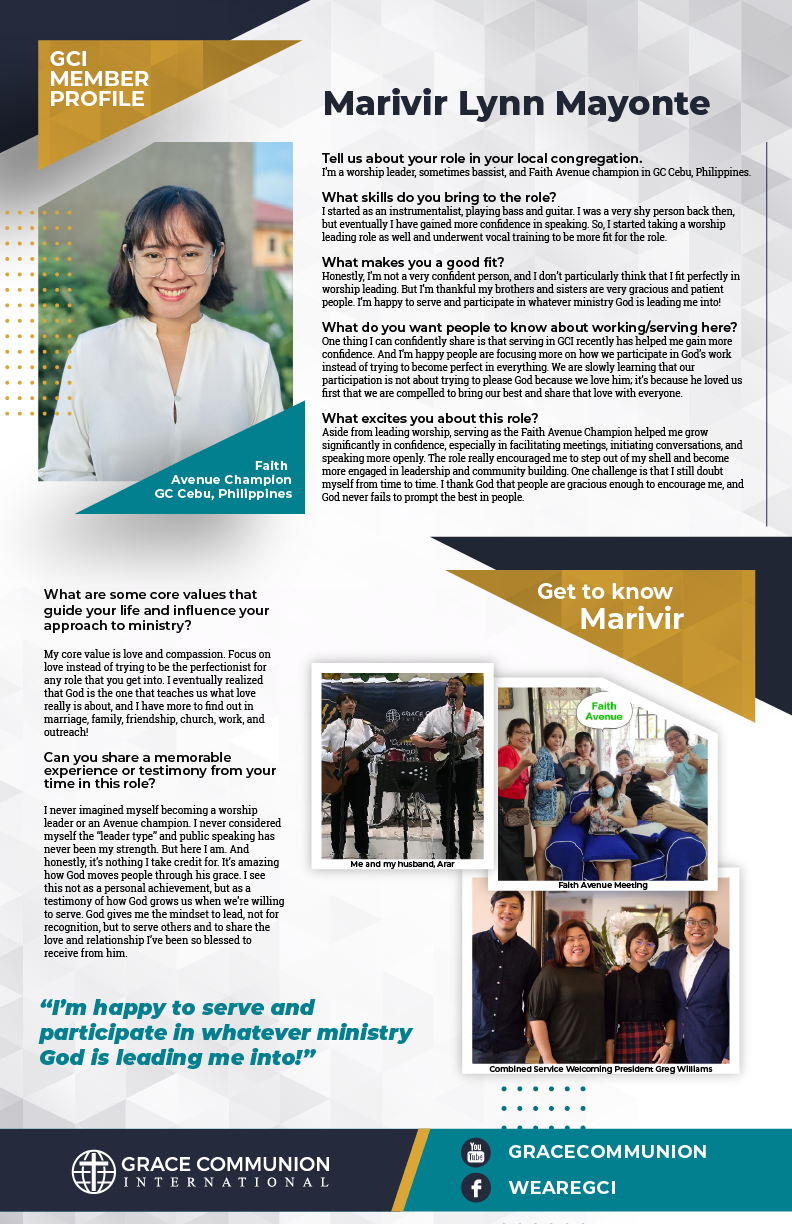
Get to know Dawson Nathaniel, Love Avenue Champion in New Ashongman, Accra, Ghana. He’s passionate about neighborhood engagement and sharing the gospel wherever he’s called. Read more here.

Building Up the Saints

How good and how pleasant for members of Christ’s Body to dwell together in unity! We’re called to work together toward being mature, equipped workers for the kingdom. It is encouraging to hear how these regions and congregations are dedicated to this purpose.


Bela-Bela, Limpopo, South Africa

A conference was hosted in Aruka center in March for the GCI pastors of South Africa. National Director Takalani Musekwa wrote: “We gathered for a historic pastoral conference, a moment that felt much like the people of Israel stepping into the land of promise with a brand-new culture.”

Waikanae, Wellington, New Zealand

“A House of Prayer” was the theme of this year’s Refresher Weekend. Thirty members from all over NZ, including six from our Masterton Filipino congregation, enjoyed a stimulating and challenging exploration of the importance of prayer in Christians’ lives.

After dinner together on Friday evening, I led an introductory session launching out of Jesus’ statement that “God’s house is to be called a house of prayer” (Matthew 21:13). I emphasized, “We are that house, so prayer must be an important aspect of our lives, and we are here to improve our prayer lives.” We concluded the session by viewing a short video by NT Wright, “How Should I Pray?”

Saturday began with another session on the Lord’s Prayer as an outline for our prayers. The ensuing weekend presentations covered the topics of “Worship in Prayer,” and “Prayers of Lament,” “Intercessory Prayer,” and “Praise in Prayer.” On Saturday evening, a Q & A session addressed questions submitted by the attendees.

Throughout the programme, there were several opportunities for members to pray individually and in small groups. For example, after explaining how the lament psalms show us that it’s never wrong to cry out to God in our pain, members wrote their own lament prayer, based on a situation important to them. Another time, members meditated and prayed through one of the psalms using a meditative prayer format known as Lectio Divina.

The programme was wrapped up with a reminder of the GCI-Australasia Vision Prayer. We are told to “devote yourselves to prayer” (Col 4:12) and to “pray in the Spirit on all occasions with all kind of prayers” (Eph 6:18), and God tells us that he “inhabits the praises of his people” (Ps 22:3).

Here is just one of the positive comments received afterwards:

“Wow, what a weekend. Thank you for helping us to learn more about the different aspects of prayer. Instead of just mere words to God, there is now a more focused, open, deeper and faith-filled dimension in our prayers. “

By Dennis Richards, Pastor
Palmerston North, New Zealand

Cleveland, Ohio, U.S.

In April, Grace Communion Cleveland hosted their annual LiLY Women’s Conference. A total of 72 women gathered for a time of fellowship, reflection, and renewal under the inspiring theme, “As He Has Forgiven You” (Ephesians 4:32).

GC Cleveland pastor, Tamar Gray, and the worship band set a powerful tone for the weekend. Attendees participated in a “Getting to Know You” activity.

GC Cincinnati pastor, Julie Frantz, shared a heartfelt message on forgiveness, emphasizing that it is not enabling abuse or seeking revenge, but rather a rejection of pride and a call to view life through Jesus.

Tess Scott, speaker and author, encouraged attendees to embrace forgiveness without shame, reminding us that God restores, and Jesus carried our burdens to the cross. Tess Scott also spoke on healing and forgiveness, emphasizing that Jesus paid our debt. She introduced four key principles: Remember, Release, Receive, and Rely. The evening concluded with moving testimonies that inspired reflection and healing.

On Sunday, Pastor Tamar Gray brought the LiLY Women’s Conference to a powerful close, urging everyone in attendance — including family members — to embrace forgiveness as a “new normal.”

As we reflect on these transformative messages, we eagerly anticipate all that the Lord has in store for 2026. Follow us on Facebook @lilywomensconference for more details.

Rosa (left) with Love Avenue Champion Pat Shiels

By Rosa Hulse, Women’s Ministry Leader
Cleveland, OH, US

Pasadena, California, U.S.

Beginning on Wednesday evening, members of GC Pasadena gathered until Sunday for a retreat in April. God blessed us with good weather — snow the whole day on Saturday. We enjoyed plenty of food and relational bonding. And of course, we had games that everyone enjoyed.

Every day, after eating our breakfast, we began with worship and a devotional. We also watched and discussed Dr. Gary Deddo’s YouTube videos, “Who Are You Lord?” parts 1–4.

One person shared this highlight: “I want to share Jesus and engage in my neighborhood.” We ended our time together with communion.

Praise God from whom all blessings flow. Thank you, Lord.

By Angie Tabin, Pastor
Pasadena, CA, US