GCI Update
Connecting Members & Friends of GCI
Header Banner

Todd Crouch

Todd Crouch (pictured at right with his wife Denise) is living one of his life’s dreams. “For as long as I can remember, even from age four or five, I have always wanted to know God and to really understand the Bible. I even talked to my Methodist minister about becoming a pastor.” Todd’s dream came true and he now pastors three GCI congregations: Wheeling, West Virginia; Washington, Pennsylvania; and Cambridge, Ohio.

Growing up in the small town of Speers, Pennsylvania, Todd’s first contact with GCI was through a cousin. “He gave me a subscription to The Plain Truth as a Christmas gift in 1974. I read it and for some reason it struck a chord…there was a real zeal. I appreciated that the WCG encouraged people to look into Scripture and that Christianity was meant to be something engaging that would change us.” Todd began attending WCG in 1981 in Belle Vernon, Pennsylvania (now the Mt. Pleasant congregation), and was baptized later that year.

Todd met his wife Denise at a church function. She was attending the Washington, Pennsylvania congregation. “In 1983 we got married and we moved to Bentleyville which is where we still live. It’s about halfway between our two families. We attended the Washington church with family.”

Todd and Denise have two sons, both married. David and his wife Elissa live in Moore, Oklahoma. David works as a SharePoint Administrator for Chickasaw Nation Industries. Elissa is a meteorologist for Weather News in Norman. They attend the Oklahoma City church. No grandkids yet.

“Our youngest son Jonathan is an officer-ranger with the Pennsylvania Department of Natural Resources and Conservation policing the state parks. His wife Jill is a forensic scientist with the Pennsylvania State Police. Jonathan is a member of the Washington, Pennsylvania church. Jill attends the church she grew up in. No grandkids yet.”

Todd, who worked in advertising, was asked to become the bi-vocational associate pastor of the Mt. Pleasant congregation in 1999. “I’m not sure what led to it other than at that time when many were leaving our fellowship, we stayed. We attended new pastors’ training at HQ in 2000. In 2005, Todd was hired full time and became the senior pastor of the three congregations.

What Todd enjoys most about being a pastor is, “Telling others about Jesus and having conversations with people about Jesus. I also love fellowship and worship. Pastors have the opportunity to participate with Jesus in ministering in many ways. You are bound up with the lives of so many and you experience so much through these relationships. Building relationships with other Christian pastors and churches is also a big plus.”

His most memorable moment as a pastor happened in Palm Springs during the International Pastors’ Conference, “when I first realized that Jesus had not left his humanity in the grave and is thus still ‘one of us’ and always will be.”

Speaking about GCI, Todd said, “God has given us a unique history and story to be a part of. I also like that so many of us know one another and have mutual friends. Also there is an intangible quality with GCI that is hard to define, but it’s there. It’s the desire, I think, to be transformed by the Holy Spirit with the focus on Jesus. We desire to know Jesus deeply and to see lives changed as we understand what Jesus has done for us all.”

Todd loves to share what God is doing with the three small churches he pastors. “We have a radio program called Fountain of Life. It is heard on a small radio station here in Washington and we have an ever-growing audience of online listeners in over 310 cities in America and all over the world at www.rkpradio.com. This shows us that Jesus uses our loaves and fish as we bring them to him.”

When does Todd feel closest to God? “In times of worship, both privately and when the church comes together.”

Jesus’ Acceptance, part 2

Here is the second part of a two-part article by Gary Deddo. For part one, click here.

In part one of this article, we saw that Jesus loves and accepts all people. We then observed that he invites those he has accepted to follow him and then discerns their personal responses. As the Bible shows, there are consequences for those responses, which we will now address.

Jesus’ discernment of the various kinds of responses made to him is evident at many points in Scripture. His parable of the sower and the seeds (the seeds being his word) makes this obvious. There are four distinct soils, and only one represents the receptive response that Jesus is looking for. On numerous occasions, Jesus talks about receiving or rejecting him, his words/teaching, his heavenly Father and his disciples. When a number of disciples turned away and left him, Jesus asked whether his twelve disciples would leave him as well. Peter famously replies, “Lord, to whom shall we go? You have the words of eternal life” (John 6:68).

Jesus’ initial initiative towards people is expressed in his invitation to “come, follow me” (Mark 1:17). There is a difference between those who follow and those who do not. Jesus likens those who follow to those who act on an invitation to a wedding and contrasts them with those who refuse the invitation (Matthew 22:4-9). In like manner, a difference is noted in the refusal of the elder son to join in the feast celebrating his younger brother’s return, despite his father imploring him to come in (Luke 15:28).

There are strict warnings to those who not only do not follow Jesus but who actively reject his invitation to the extent of preventing others from following him, some even plotting to have Jesus executed (Luke 11:46; Matthew 3:7; 23:27-29). These warnings are severe—indicating what the person issuing them does not want to happen, not what they hope will happen. Warnings are given to those whom we care about, not to those for whom we have no concern. The same love and acceptance is exhibited towards those who accept Jesus and those who reject him. However, such love would not be loving if it then failed to note the difference of response and the corresponding consequences.

Jesus welcomes and invites all to respond in a receptive way both to him and to what he offers, which is the reign of the kingdom of God. Though the net is cast wide and the seed is sown everywhere, receiving, trusting and following him call for a particular response. Jesus likens it to the reception of a child. He calls such receptivity faith/belief or trust in him. It includes repenting of putting one’s ultimate trust in anyone or anything else. It is summed up in worshiping the Father through the Son and in the Spirit. The gift is offered freely and extended to all. No pre-conditions are set out to limit or restrict who might benefit from it. However, the reception of the freely given gift always involves a cost to the recipient. That cost is to give up one’s entire life and hand it over to Jesus and the Father and the Spirit with him. The cost is not something paid to Jesus to enable or incline him to give himself to us. It is the cost of emptying our hands and hearts to receive him for who he is, our Lord and Savior. What is freely given is costly to us to receive because it involves dying to the old and corrupted self in order to receive new life from him.

The cost to us to receive God’s free grace is referred to throughout Scripture. In the Old Testament, we are said to need both new hearts and new spirits that God himself will one day give! In the New Testament we are told that we need to be born again from above, that we need new natures, that we must stop living for ourselves and begin living under the Lordship of Christ, that we must die to our old natures, that we are to become new creations, that we are to be regenerated, that we are being renewed according to the image of Christ, the new Adam. The day of Pentecost indicates not only God’s sending of his Spirit to indwell his people in a new way, but our need to receive and be indwelt and filled by his Holy Spirit, the Spirit of Jesus, the Spirit of life.

Jesus’ parables indicate that the response he is looking for, the response that indicates the reception of what he offers us involves a cost to us. Consider the parables of the pearl of great price or the purchase of a field in which there is a treasure. Those who respond appropriately must give up all they have to receive what they have found (Matthew 13:44, 46). Those who place other things as a priority, whether they be lands or home or family, are not receiving Jesus and his benefits (Luke 9:59, Luke 14:18-20).

Jesus’ interactions with people indicate that following him and receiving all his benefits calls for the abandonment of anything we might value above Jesus and his kingdom. That includes abandoning the pursuit and possession of material wealth. The rich ruler did not follow Jesus because he could not part with his goods. Consequently he was unable to receive the good that Jesus offered him (Luke 18:18-23). Even the woman caught in adultery was called to set out in a different direction of life. Receiving forgiveness was to be followed by her sinning no more (John 8:11). Recall the man at the pool. He had to be willing to leave behind his place at the pool as well as his diseased self. “Get up! Pick up your mat and walk” (John 5:8).

Jesus welcomes and accepts all but a receptive response to Jesus does not leave anyone where Jesus finds them. Jesus would not be loving if he simply left them in the condition in which he first encountered them. He loves us too much simply to leave us alone as though he merely empathizes with us or feels sorry for us. No, his love is a healing, transforming, life-changing love.

In sum, the New Testament consistently declares that the response to the free offer that Jesus makes of himself, including all that he has for us, involves denying (dying to) ourselves. It involves giving up our pride, our confidence in ourselves, in our religiousness, in our gifts and abilities including our ability to manage and give ourselves life. In that regard, Jesus shockingly declares that compared to following him we must “hate our father and mother.” But more than this, following him calls for hating our own life—the false idea that we can give life to ourselves (Luke 14:26-27). When we accept Jesus, we cease living for ourselves (Romans 14:7-8) because we belong to another (1 Corinthians 6:18). In that sense, we are “slaves of Christ” (Ephesians 6:6). Our lives are completely in his hands, under his provision and direction. We are who we are in relationship to him. Because we are united to Christ, “it is no longer I who live, but Christ who lives in me” (Galatians 2:20 ESV).

Jesus does accept and welcome one and all. He died for all. He is reconciled to all. But he does this as our Lord and Savior. His welcome and acceptance are an offer, an invitation that calls for response, for receptivity. And that acceptance and receptivity necessarily involves receiving exactly what he has to offer according to who he is. Nothing more and nothing less. This means that responding to him will involve repentance, getting rid of anything that blocks receiving from him what he has to offer, that blocks communion with him and the enjoyment of life in his kingdom. Such a response is costly to us—but a cost well worth it. For in dying to our old selves, we receive a new self. We make room for Jesus, receiving with emptied hands his life-transforming, life-giving grace. Jesus accepts us wherever we are in order to take us to where he is going, which is to be with his Father in the Spirit now and for all eternity as his healed, whole, regenerated children.

Who would want to be included in anything less than that?

Spanish-speaking leader development

This update is from GCI district and church pastor and church planter Heber Ticas.

Spanish logo 4 feet - version 2For the past two years the Spanish-speaking district that I lead in Southern California has been participating in a leadership/pastoral development program. We invited both established and emerging young leaders from our seven congregations to attend ten intensive daylong training sessions held over a two-year span.

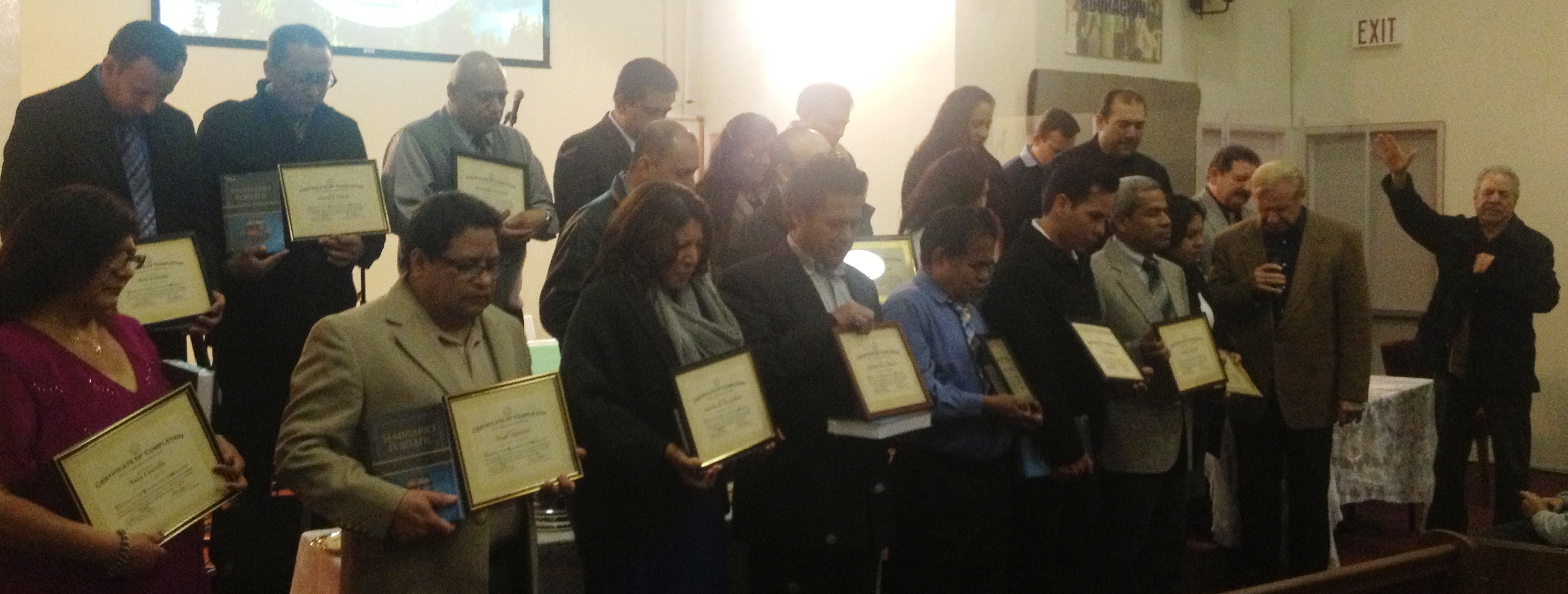
Dan Rogers, Mike Morrison, Lorenzo Arroyo (shown teaching below), Ben Escalante, Manuel Ochoa, Jose Luis Escalante and I provided teaching, including introduction to the Old and New Testaments, Trinitarian theology and incarnational missional ministry.

It is with great joy and expectation that I report that 21 participants graduated from the program last month (see picture below). On December 7 we held a district-wide gathering where participants were recognized with diplomas presented by Dr. Dan Rogers. It was a great time of fellowship and celebration as we thanked our Lord for his grace over our Hispanic work in this region.

It is my expectation that we will continue to develop emerging leaders with the purpose of sending them to their local congregations for leadership and missional work. I also expect that some in this group will become church pastors, church planters and/or participants in a launch team to plant new GCI Spanish-speaking congregations.

I have set as a goal for our Spanish district to multiply itself to 14 congregations in the next 7-10 years. Please join me in prayer about this goal—thanking our most loving God for his grace with respect to our Spanish work.

Death of Gervaise Amundson

We are saddened to learn of the death of Gervaise Amundson, wife of GCI pastor Don Amundson of Austin, Texas.

Gervaise went home to the Lord on Christmas Eve at around 8:00 p.m. She had been in hospice care for three days following a long battle with Alzheimer’s disease. Her last meal was some ice cream that Don fed to her. It was one of Gervaise’s favorites.

Cards may be sent to:

Don Amundson
8114 Shenandoah
Austin, Texas 78753-5735

Mike Swagerty

Swagerty
Sandy and Mike Swagerty

Mike Swagerty’s career track made a radical turn at a young age. He explains: “I have never been convicted as an arsonist, but as a child I am afraid I was a budding pyromaniac. At age eight I started a fire on our farm that nearly burned down all the houses and out-buildings. Needless to say the punishment that was forthcoming basically got me over my ‘fire bug’ ways.” Mike has replaced pyromania with playing cards. “I love to play cards, especially bridge. I have belonged to a Thursday night bridge group for many years.”

Mike, who pastors GCI’s church in Sacramento, California, lives about 100 miles from where he grew up. “I grew up on a peach farm about 11 miles southeast of Modesto. I never moved from birth until college from that farm. After being accepted to college and being ordained a minister at graduation, I simply moved wherever HQ told me to go. My first assignment was in Toledo, Ohio and my last transfer was to Sacramento in 1991.”

At age 15, Mike started listening to The World Tomorrow radio broadcast. “I remember the question on the broadcast that caught my interest: ‘Why were you born?’ This led to booklets, 58 Correspondence Course lessons, magazines and then applying to college after my graduation from high school. I became a baptized member of GCI during my freshman year at Ambassador College in 1964.”

Mike and his wife Sandy will celebrate their 46th wedding anniversary in May 2014. “I met Sandy while we were in college in Pasadena. Funny that we didn’t even date until we were seniors. Our final week was a real whirlwind. We got married on a Sunday. We graduated and I was ordained the following Friday. By Monday we were headed for Toledo, Ohio, our first pastoral assignment.”

Mike and Sandy have two sons. “Terry, our first, was born while we were finishing our stay in Toledo. He was only three weeks old when we traveled to New Jersey. Our second son, Robert, was born in New Jersey. Terry is now 44 and Robert is 40. We have four grandchildren—a boy and a girl from each son. The boys are Jakob and AJ,and the girls are Trinity and Maddie.”

When asked what he enjoys most about being a pastor, make replied: “There’s almost nothing I don’t enjoy—even the paperwork. But my greatest love is sharing the lives of people. I have met so many interesting people over the years and I never get tired of hearing their stories.”

Mike has several stories of his own. “The one that stands out is a baptism in a stream. I was in my suit and didn’t have a bathing suit. So I took off my socks and shoes, and my coat and tie, and rolled up my pants. I was baptizing a lady and her adult daughter. The bottom of this stream was covered with round stones that had moss growing on them. The footing was treacherous. Just as I bent over to lower the daughter into the water, my foot slipped and the whole crotch of my pants tore from one end to the other, leaving me just a bit exposed! Not to be defeated, I tied my coat around my waist like an apron and we finished the baptism. Funny thing, the mother was a seamstress and we went back to her house where she sewed up my pants!

Sandy is a big part of Mike’s ministry. “Besides helping me with office work, visitation and all the normal things pastors’ wives do, Sandy has hosted a women’s small group at our home for 18 years. She has been involved as a singer on the worship team for our entire 22 years here. She has been very much involved with Connecting and Bonding, which is an outreach to ministers’ wives led by Jannice May. Sandy is a prayer warrior, never missing the opportunity to add to her considerable prayer list. She also works as a cashier at Target, where I refer to her as “Mother Teresa,” as she is always a good listener, comfort giver, and prayer partner for all who come through her line.”

When asked what he loves about GCI, Mike shared, “The fellowship and the many friends. We have folks scattered all over the world that we consider friends. I know of no other church denomination that can say this.”

When asked about his passion, Mike said, “My passion right now is to pass along my faith to the next generation. I am very active in the lives of my children and grandchildren. In the last two years I have found a real interest in summer camp. I am part of the team preparing to start a new GenMin camp at Lake Tahoe.”

Mike feels closest to God “in the early morning, and especially in the beauty of his creation. I love my morning time spent with God at around sunrise each day.”

Jeff McSwain ordained

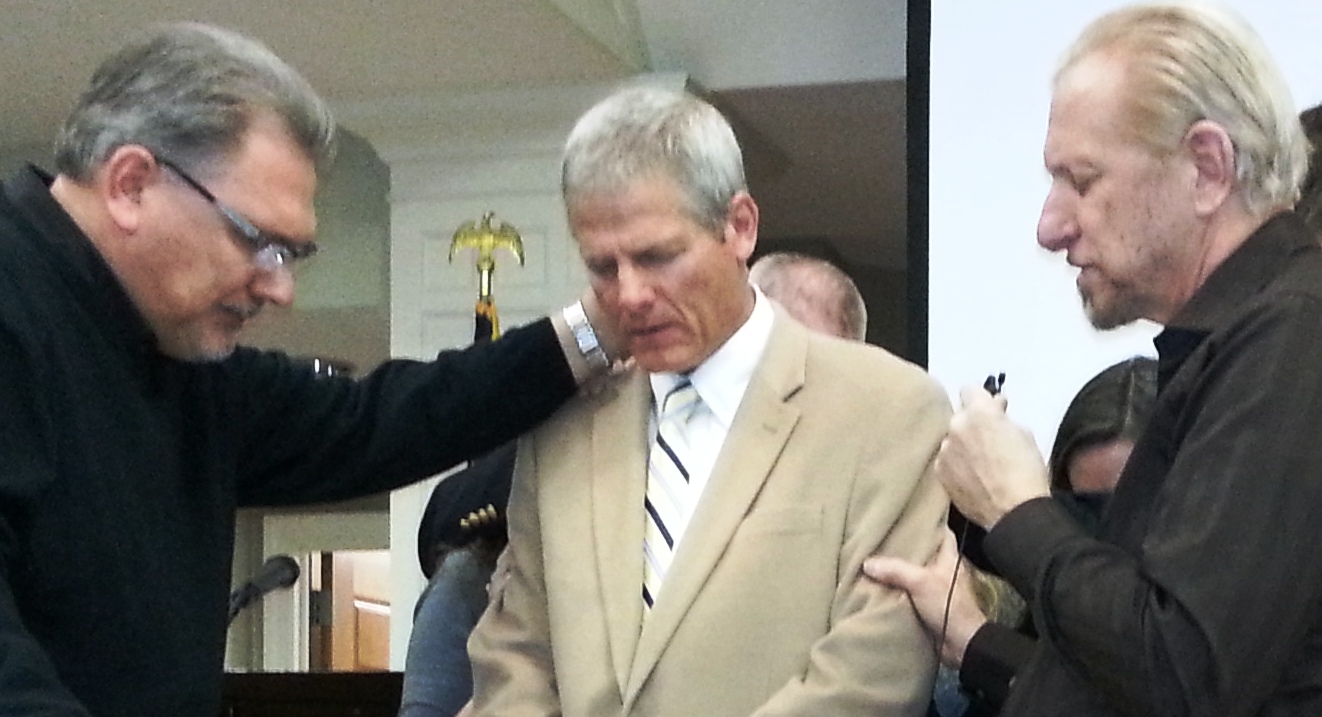
ordinationWe are pleased to announce that Jeff McSwain (at center in the picture at right) was ordained a GCI elder on January 5. The ordination occurred during the worship service of Celebration Christian Fellowship, GCI’s Raleigh, North Carolina area congregation.

The ordination was performed by Dan Rogers, director of Church Administration and Development (at right in the picture) and Greg Williams, associate director (at left). The audience included Jeff’s family and several GCI pastors and pastoral interns in Raleigh for a GCI Pastoral Internship Program conference.

Jeff is now serving on the team that leads GCI’s internship program, working part time while he finishes his PhD in theology at St. Andrews University in Scotland.

To learn more about Jeff, including several You’re Included interviews, go to http://www.gci.org/category/people/jeff-mcswain.

Death of Miles Johnson

Miles
Miles Johnson

We are saddened to learn of the death of GCI elder Miles Johnson who served at New Covenant Fellowship, GCI’s Glendora, California congregation.

According to Miles’ pastor, Neil Earle, Miles died of a heart attack one month short of his 82nd birthday. Miles is survived by his wife Marcia, one daughter, two sons, two grandsons and one great-granddaughter.

Cards may be sent to:

Mrs. Marcia Johnson
1338 N. Bender Ave.
Covina, CA 91724-1007

Exponential 2014

ExponentialGCI Church Administration and Development recommends Exponential 2014—a conference for pastors and ministry leaders who want to learn about church planting and renewal—with an emphasis on participating in what Jesus is doing in their local communities. In 2014, Exponential will be held in two locations:

  • Orlando, Florida on April 28-May 1
  • Los Angeles, California on October 6-9

The theme for this year’s conference, Seek + Save, is based on Luke 19:9: “The Son of Man came to seek and to save the lost.” It will take a fresh look at evangelism. In doing so it will rethink and challenge some old paradigms, helping us rediscover Jesus’ timeless truths.

The conference features plenary sessions conducted by internationally known church planters and ministry leaders. Also featured are pre-conference intensives and more than 125 workshops—all related to church planting and church development.

To register and for more information go to www.exponential.org. Here is an informational video:

Dave Ferguson on Exponential 2014 Theme from Exponential on Vimeo.

Jesus’ Acceptance, part 1

Here is part one of a two-part article by Gary Deddo. For part two, click here.

Christians often joyfully proclaim that “Jesus accepts everyone” and “does not judge anyone.” Though there is gospel truth in these affirmations, I find that people assign to them a wide range of different meanings. Unfortunately, some of those meanings seem to differ from the revelation of Jesus that is given to us in the New Testament.

In GCI circles, we often use the phrase, “You’re included.” That simple statement conveys an important point. But it too can be (and has been) understood in a variety of ways. What exactly are we included in? Answering this and related questions calls for care as we, in faith, seek to sort out the related issues so that we are accurate and thus faithful to the biblical revelation.

Jesus certainly did welcome all into his presence and offered himself and his teaching to all who came toward him. In fact, he told his listeners that he would draw all persons to himself (John 12:32). Indeed, we find no instances where Jesus rejected someone, turning away from or refusing someone who was seeking him out. More than that, Jesus received and even shared meals with the sorts of people who were being rejected by many of the religious leaders of his day.

What stands out in the biblical record is the fact that Jesus welcomed and interacted with lepers, the lame, blind, deaf and dumb. He interacted socially with women (some with questionable reputations) and did so in ways that ignored religious regulations of the day. Jesus also spent time with adulterers, with Jewish tax collectors working under Roman direction, and even with fanatical anti-Roman political activists.

Furthermore, Jesus spent time with the Pharisees and Sadducees, religious leaders who were his most severe critics (including some who plotted his execution). The apostle John tells us that Jesus did not come to condemn, but to save and rescue people for God. Jesus said, “whoever comes to me I will never drive away” (John 6:37). He also instructed his disciples to love their enemies (Luke 6:27), forgive those who wronged them and bless those who cursed them (Luke 6:28). Jesus also extended forgiveness to his executioners at the moment of his crucifixion (Luke 23:34).

What comes across in these examples is that Jesus came to benefit all—he was “on the side” of everyone, he was “for” everyone. He is God’s grace and God’s salvation for all. The rest of the New Testament outside of the Gospels summarizes what we see lived out in Jesus’ life. Paul indicates that Jesus came to atone for the sins of the ungodly, the sinners—those “dead in their sins” (Ephesians 2:1).

The attitude and acts of Jesus clearly demonstrate God’s love for all human beings and his desire to be reconciled to all and to bless all. Jesus came to give life and to give it abundantly (John 10:10 NRSV). God was in Christ reconciling the world to himself (2 Corinthians 5:19). Jesus came as a ransom to free captives of sin—their own and the evil done against them.

But there is more to the story—a “more” that should not be viewed as contradicting or in tension with what we just surveyed. Contrary to the view of some, there is no necessity to think that there are contrasting or conflicting aspects within Jesus’ heart, mind and purposes. There is no need to see some sort of internal balancing act, now tipping one way then correcting and tipping the other. There is no need to think that Jesus is trying to accomplish two divergent things at the same time such as love and righteousness or mercy and holiness. Such imagined tensions might exist within us in our fallenness, but they do not exist within the heart of Jesus or his Father.

Jesus, like the Father, welcomes all people. However, he does so with a particular purpose in mind. His love has direction to it. He engages all who will listen to reveal something that is generally hidden. He came to give something in particular—to serve all in a way that points in a particular direction, that has a certain goal or end in mind.

Rather than an end point, his welcome to all is the starting point of an ongoing relationship. That relationship is one of his giving and serving and of our receiving what he offers. Jesus does not offer any old thing or serve us in any old way (including the way we might prefer). Rather, he offers us only the best that he has—and that is himself. And in offering himself he gives us the way, the truth and the life. Nothing more. Nothing else.

Jesus’ attitude and acts of receiving and welcoming call for a certain response to his self-giving. In essence, it calls for receiving what he offers. In contrast to that receptive response, there is the response of rejecting what Jesus offers, which means rejecting Jesus himself. By Jesus drawing all people to himself he is looking for the response of reception. And as Jesus indicates, that response requires a certain attitude, a certain approach toward him.

Jesus thus announced to his disciples that in his presence the kingdom of God had drawn near. All of the kingdom’s blessings are available in him. However, Jesus immediately indicated what response that truth and reality calls for: “Repent and believe in the good news” of the kingdom’s arrival. A refusal to repent and put faith in Jesus and his kingdom amounts to a rejection of Jesus and the benefits of his kingdom.

A willingness to repent requires an attitude of humble receptivity. And that is what Jesus is looking for in extending his welcome, his acceptance. For it is only through humility that we are able to receive what Jesus has offered. And note that Jesus offers his gift before any such response is made. In fact, it is the offer of the gift that calls forth the response.

Repentance and belief are thus the responses of reception to what Jesus has already offered. Those responses are not behaviors or attitudes that pre-condition Jesus’ offer, or determine to whom he makes the offer. Jesus’ offer is for the sake of its reception—not for the sake of its rejection. Of what benefit would such rejection be? None.

The receptive attitude Jesus is always looking for in response to his offer of himself is indicated in a variety of his sayings: “For the Son of Man came to seek and save the lost” (Luke 19:10 NRSV). “It is not the healthy who need a doctor, but the sick” (Luke 5:31). “Truly I tell you, anyone who will not receive the kingdom of God like a little child will never enter it” (Mark 10:15). We must be like the soil that “receives the word” of the sower “with joy” (Luke 8:13). “Seek first his kingdom and his righteousness” (Matthew 6:33).

Receiving what Jesus offers, and so benefitting from what he gives, requires acknowledging that we are lost and need to be found, that we are ill and need a physician to heal us, that we come to Jesus to receive with empty hands, not hoping to make an exchange with him. For like a child we do not presume to have anything that he needs. This is why Jesus indicates that it is the “poor in spirit” who are receiving the blessings of God and his kingdom, not those who regard themselves as spiritually rich (Matthew 5:3).

Christian teaching has summarized this attitude of receptivity to what God in Christ freely offers to all his creatures as one of humility. This is an attitude that admits that we are not self-sufficient but must receive life from our creator and redeemer. The opposite of such a trusting and receptive heart has been called pride. In the context of church teaching, pride is an attitude that asserts autonomy from God, a trust in oneself, a confidence in one’s own adequacy, even in the face of God. Such pride is offended by the suggestion that one needs to receive anything significant from God, most especially his forgiveness and mercy. Pride then results in a self-righteous refusal to receive anything essential from God, particularly those things you think you can provide for yourself. Pride insists on paying its own way, getting what it deserves. It insists that it does not need grace or charity from God—that it can provide itself with life sufficient for its own purposes. Pride refuses to “be beholden” to anyone or anything, including God. Pride says nothing really needs to be changed in us. We are fine just as we are. In contrast, humility recognizes that one cannot give oneself life. Instead, it admits its need not only for help, but for the transformation, renewal, restoration and reconciliation that only God has to give. Humility acknowledges our inexcusable fault and our utter helplessness to renew ourselves. We need total grace from God or we are lost. Our pride needs to be put to death that we might receive life from God himself. Receptivity to receiving what Jesus has to offer and humility are inseparable.

In the end, Jesus welcomes all in order to give them himself. His welcome is thus purposeful. It leads somewhere. His purpose necessarily includes what reception of him requires. Jesus tells us that he has come to enable the worship of his Father (John 4:23). This is his most comprehensive way of indicating the purpose of his welcome and acceptance of us. Worship is a way of indicating a total response to who God is as the only one who is worthy of our ultimate trust and loyalty. Jesus’ self-giving leads to a true knowledge of the Father and a receptivity to his Holy Spirit. It results in worshipping God alone through the Son and in the Spirit, that is, to worshipping God in truth and in spirit. For in offering himself to us, Jesus gives himself to be our Lord, our prophet, priest and king. In doing so he reveals the Father and sends us his Spirit. He gives of himself according to who he is, not according to who he is not, nor according to our wishes or imaginations.

And this means that Jesus’ way involves discernment—it does sort through and notice the kinds of responses made to him (and to all that he offers). Jesus recognizes those who are rejecting him and his word and so those who are rejecting a true knowledge of God and right worship. He discriminates between those who are receiving and those who are not receiving. However, this discrimination does not mean that Jesus has a different attitude or intention other than that which we surveyed above. There is no reason to suppose that Jesus’ love is diminished or contradicted by his acts of discernment. Jesus does not condemn those who reject his welcome and invitation to follow him. But he does warn them concerning the consequences of such rejection. Jesus’ acceptance and love calls for a particular kind of response, not giving no response or any sort of response.

Next time, in the second part of this article, we’ll look more at that response.