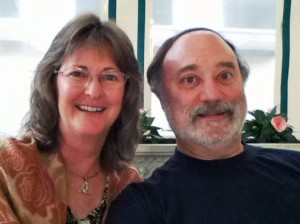
Please pray for Manfred Kraus, who at age 75, leads a GCI house church in southern Germany. Manfred was hospitalized recently due to serious intestinal bleeding. The specific cause for the bleeding has not been determined. He is home now and sees his time in the hospital as a blessing as he was able to use his stay to share the gospel with four people.
Cards may be sent to:
Manfred Kraus
Donauwörther Str. 8
86154 Augsburg
Germany
David Botha’s first love was the game of cricket. Now pastoring GCI churches in Akron and Cleveland, Ohio, David doesn’t have nearly as much opportunity to play.
David’s love for cricket developed while growing up in South Africa. “Though in my early years we moved around a lot, I grew up mostly around Johannesburg. My parents met at Ambassador College in Bricket Wood, England, so I grew up in the WCG. I spent most of my time focused on cricket and field hockey. I also loved watching game in the wild and often went on vacations to game parks. A highlight of my youth was attending SEP South Africa three times.”
After high school, David applied to attend Ambassador and initially was turned down. “So I attended Rand Afrikaans University, where I studied Mechanical Engineering for a year and a half, before being accepted to Ambassador in Big Sandy. I graduated there in 1996. While there, I met Lynne Emery; we married in 1996.” David and Lynne have two daughters, Margaret, 14, and Madeline, 12.
After college, David and Lynne moved to Oregon and got involved in the local church. Soon they felt a call to get more involved locally. “We left WCG in 2002 to attend an evangelical church that was closer to where we lived. We attended there until early in 2006, when we moved to Mississippi to serve as field missionaries with Forward Edge International. We facilitated short-term mission trips doing relief work in the aftermath of Hurricane Katrina.”
Based out of Moss Point, Mississippi, David coordinated and facilitated the work of teams in rebuilding homes and churches. During that time, David felt God moving him back toward GCI. “While in the mission field, we were supported by, among others, two GCI congregations then pastored by Glen Weber. Frequently he would ask me what our plans were for when we would leave the mission field in Mississippi. He wanted me to serve as a pastor in his district. This calling to pastoral ministry was confirmed in another confersation with Jeff Broadnax.”
David responded to this call and was hired into full-time ministry with GCI in 2008. “In November we moved to Akron, Ohio, where I now serve as senior pastor of the Akron and Cleveland congregations. We are now working diligently on a new church plant.”
Lynne is an integral part of David’s ministry “helping,” as she puts it, “in whatever way is needed—whenever and however that looks. It could be as simple as paperwork or babysitting, or as involved as moving to another state.” Lynne visits the sick and shut-ins, and she and David double-date on counseling sessions. She fills in to preach or to handle calls when David is out of town. Lynne said she “also runs interference when David’s overwhelmed, counsels those to whom he refers me, assists in the coordination/realization of events for missions or church, and facilitates mission teams. My first duties are to care for David personally, to spend inordinate amounts of time praying for him, to raise our children and to keep our home.”
When asked what he enjoys most about being a pastor David said, “Seeing people become the mature disciple that God has called them to be.” His most memorable moment was “getting to baptize my daughter.”
Talking about GCI, David said he loves “being part of a group that actually cares about others.” Ministry helps fill David’s passion of “seeing people grow in Christ.” Asked when he feels closest to God, David replied, “When I lean on him and he uses me, beyond my capabilities, to encourage others.”
The 2014 round of GCI regional conferences in the U.S. was completed recently in Orlando, Florida. Attendance was up overall from previous years. In addition to the Orlando site, conferences were held in Ontario, California; Vancouver, Washington; Chicago, Illinois; Somerset, New Jersey; Lexington, Kentucky; and Dallas, Texas.
The 2014 conference theme, GCnext: Sharing Jesus’ faith, love and hope, refers to our progress toward GCI’s future (GCnext), which means a Spirit-led journey forward sharing in Jesus’ own faith, love and hope. The theme scripture for the conference makes reference to this vital “faith triad”:
We continue to remember before our God and Father your work produced by faith, your labor prompted by love, and your endurance inspired by hope in our Lord Jesus Christ (1 Thessalonians 1:3).
Plenary conference presentations were given by Dan Rogers on faith, Joseph Tkach on love, Greg Williams on hope, and Gary Deddo on how all three interrelate in the person and work of Jesus. A fourth plenary session featured GCI members sharing stories about what they see the Holy Spirit doing in and through their churches and ministries. It was a highlight of the conference to hear the variety of ways the Spirit is helping us participate in what Jesus is doing to fulfill the Father’s mission to the world. These stories showed the great resourcefulness and creativity being displayed by GCI members as, together, we journey, on mission, with Jesus.
We’ll let you know when videos of the plenary sessions are posted online. In the meantime, here are some pictures from the Dallas and Orlando conferences:
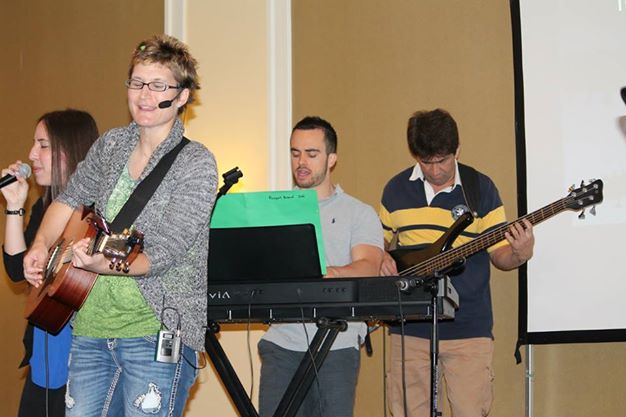
Members who attended from the Wichita, Kansas church.Thanks to all, like Nancy Akers, who worked behind the scenes to make these conferences possible.Dan Rogers leads a breakout discussion group.There were many opportunities for small group discussion.Greg Williams gives the closing sermon.Lots of table fellowship!Informal one-on-one discussion.Michelle Fleming tells about a new GCI church in Orlando.Part of the band that led worship in Orlando.
Grace Communion Seminary dean of faculty, Michael Morrison, recently reviewed a helpful book that examines the life and theology of Thomas F. Torrance.
The book, Theology in Transposition, was written by Trinitarian theologian Myk Habets. On page one of the book, Myk mentions GCI, noting that we, as a denomination, have embraced and now teach Trinitarian theology.
Click here to read Mike’s review on Amazon.com where the book is sold.
This update on a previous prayer request for Lorraine Wilson is from her husband, GCI pastor Warren Wilson.
Lorraine has healed well from her thyroidectomy, though without a thyroid her TSH (thyroid stimulating hormone) levels are low, causing her to feel very tired all the time. The next step is for her to have thyroid ablation using radioiodine. She is still working, but that’s getting increasingly difficult given her lack of energy.
Please pray that Lorraine can hang on until she can start taking synthroid (synthetic thyroid hormone).
Cards may be sent to:
Lorraine Wilson
220 Waverly Way
Clarksburg, WV 26301
Tom Ecker, pastor of GCI’s congregations in Beaumont and High Desert, California, has been affiliated with GCI since birth. “The year I was born my mother started listening to the WCG radio program, and for several years after I listened from my high chair. My mother and dad did not agree on religion, so I went to church with my dad until shortly after my parents divorced when I was 16. After that, I did not attend any church for about three years.”
Tom’s family moved from Kansas, to Beaumont, California, when Tom was five. As Tom tells it, he almost didn’t come with them. “I ran away from home, but stopped two blocks away when I ran into a huge dog. I stood there and cried until my mom came and chased me all the way home. It was good that I stayed around for the move to California as my parents chose to live in an area where we had two beautiful orchards with fruit trees, where I spent many happy hours playing with my friends.”
“I attended all twelve years in the Beaumont Unified School System, and enjoyed football, basketball and track. God blessed me with speed, so I lettered in varsity track all four years. I received good coaching from a man who taught me never to quit when things get tough. I was the starting halfback on the only football team in Beaumont history to win the equivalent of a state championship. I was also captain of the track team and set school records that held for a couple of decades. In my senior year, I was elected student body president. All these experiences taught me the value of hard work, the joy of being part of a team, and the importance of friendship.
After high school, Tom attended California Polytechnic University (Cal Poly) in Pomona for two years. “During this time my mother became very ill, and a lady in the church took her into her home and nursed her back to health. This impressed me so deeply that I was led to check out the church in more detail. I began reading The Plain Truth during lunch breaks. I read the article, “The Man Who Could Not Afford to Tithe” and my mother was surprised when I gave her my tithe check. She wisely handed it back to me and said, “You should send it in yourself.” I did, and began attending church about three months later. I applied for Ambassador College, and was accepted for the fall of 1970.”
Tom had many sport and leadership opportunities at Ambassador, which he said, “put ingredients in my life that led me to appreciate our collective calling. As a senior in 1973, I was asked and enthusiastically agreed to become a ministerial trainee, not knowing the great joys and sorrows that lay ahead over the next 41+ years. I was married to my first wife in June 1973 and arrived in Toronto, Ontario, Canada in July 1973. I served in a variety of locations in Canada for 21 years and now am in my 21st year of ministry in the USA, now in California.”
Tom and Alberta (Awana) have been married for over 18 years. “We met in a prayer group at the old HQ Auditorium—the first group on campus led by a woman, Alberta. She received permission to be leader from Joseph Tkach Sr. We prayed together in a group before we ever dated. Nine months later we were married by Joseph Tkach Jr.” Tom notes that Alberta continues to serve actively in ministry to this day.
Tom and Alberta have a large family. “Alberta has five children: Robert, Rose, Jerry, Jennifer, and Eugene. I had one son, Ryan, from my first marriage. Sadly, he is deceased. We have seven grandchildren and two great-grandchildren, scattered all over the United States.”
When asked what he enjoys most about being a pastor, Tom said that he and Alberta “enjoy the ongoing variety of serving God and ministering to his precious called-out-ones through five ministries that he summarizes with the acronym VASES: Visiting, Administrating, Socializing, Evangelizing and Speaking. “The acronym reminds us that in serving God in these ways, ‘the all-surpassing power is from God and not us’ (2 Corinthians 4:7).”
When asked what he values most about GCI, Tom said, “Alberta and I appreciate being in a church that is willing to change and grow—not afraid to learn something new, and one that appreciates the redeeming qualities of all cultures.”
Though Tom has had numerous memorable moments in ministry, he mentions one type in particular: “Attending or officiating at over 200 funerals. Each time I am reminded of how a funeral is a tribute to our great God, who has carried out his purposes and applied the fruit of Christ’s redemptive mission in the life of that person. This is both humbling and a cause for rejoicing, as I view funerals as a ‘graduation,’ knowing that this believer has died in the faith.”
When asked about his passion, Tom said it “is to bear witness to the amazing Trinitarian theological truth that the Father, Son and Spirit are involved together in the mission of Jesus Christ. This passion leads us to encourage people to recognize, realize, internalize and personalize the reality of the life of Christ Jesus as being their true life.”
Tom says he feels closest to God when practicing the various spiritual disciplines. “One of the blessings that Alberta and I share together is reading daily in the One Year Bible. Doing so provides us with a wonderfully balanced spiritual diet.”
In the video below, Collette Bliss, a camper at GenMin’s The Rock camp in North Carolina, recites for the assembled camp a powerful and insightful poem that she wrote entitled “Make Up.” It’s inspiring to see the creativity of our Triune God being expressed in and through one of our young leaders!
This update is from Carl Fredrik Aas, GCI’s regional pastor for Scandinavia.
I returned recently from participating in the summer school that we as a church run in the town of Kallaste, Estonia (pictured at right). It was a success in every way. We had about 40 students (some of them are pictured below), which is not bad considering the regular school in Kallaste has 70 students.
Our teachers and other staff members came from Norway, the USA, Sweden, England and Estonia. They did a fine job as a team. The mayor of Kallaste visited one day to thank us for holding the summer school in his community.
School activities included helping 8 to 12 year olds practice English. The 13 to 15 year olds were taught about friendship, courage, success, integrity and identity. Some of the 13 to 18 year olds were taught to play piano. A former student taught the 13 to 15 year olds to play chess (see picture at right). Other students played American football and volleyball, studied English, learned to give speeches, learned to be interviewed for a job, and learned to prepare meals.
I taught a “Principles of Living” class for the 16 to 18 year olds. We discussed success, budgeting, marriage and sexual relations. I also taught an adult English class, which was a lot of fun.
On Friday evening we held an informal time of socializing together with good food, beverages and fun. The students enjoyed trying to teach me Russian! We all had a good laugh!
The last day of school we held a graduation ceremony in which the local English teacher and I gave short speeches. On the diplomas handed out was this quote: “A friend in need is a friend indeed. The friends you choose will help you win or lose.” I expounded on these points.
The highlight of the week was the baptism of Karyn Sanders. As she was being baptized in a local lake, a thunderstorm rumbled in the distance. It reminded us of God’s presence at Mt. Sinai.
Here are some “fast facts” about people in the U.S. and elsewhere, published in the August issue of Evangelism Connection from Mission America. The list illustrates the importance of researching the nature of the communities that we seek to reach with the gospel.
Only 11% of those who abandon their childhood Christian faith had a very strong faith as a child and came from a home where a vibrant faith was taught and practiced.
Only 18% of young adults raised with any religion are now unaffiliated with a particular faith.
Only 1 in 4 Americans aged 18 to 29 who are Christians are white vs. 7 in 10 for older Americans.
More than half of America’s young Christians are people of color.
1 out of 3 Americans would be happy if an immediate family member married a born-again Christian.
88% of U.S. households own at least one Bible, and the average number of Bibles per household is 4.7.
Only 37% of Americans report reading the Bible once a week or more.
Of those who read Scripture regularly, 57% give a lot of thought to how it might apply to their life.
Approximately 150 million Americans are not engaged with any religious community.
About 800 to 1,000 Southern Baptist congregations cease to exist annually.
75% of people who died from religious hostility in ’12 were Muslims killed by Muslims.
Moms are the primary breadwinner in 40% of U.S. homes with kids under 18.
The average cost of a nonfatal disabling auto accident in the U.S. is $78,700.
9% of Americans would be happy if a family member married someone of a different race.
10% of Americans would be happy about a marriage to someone born and raised outside the U.S.
6% of Americans would be happy about marriage to someone who didn’t go to college.
82% of Millennials in the U.S. want to get married vs. 62% of the overall unmarried population.
72% of U.S. Millennials believe career is essential to their personal identity.
42% of U.S. mothers say they reduced work hours in order to care for a child or family member.
College grads in the class of 2014 average $33K in debt.
70% of women have mobile phone separation anxiety vs. 61% of men.
In the next 24 hours, 12 young people will have died as a result of murder.
Last year, 39% of U.S. adults donated to a nonprofit organization to help people in extreme poverty.
Roughly 40 million Millennials are now parents.
47% of U.S. women ages 15 to 44 have no children.
70% of working moms envy the time stay-at-home moms get to spend with their kids, which can lead to guilt.
60% of working moms would quit their jobs if it weren’t for the money.
75% of stay-at-home moms agree they have the best job, but 50% miss adult interaction and wish they were at work.
The majority of stay-at-home moms envy working moms’ incomes.
43% of working moms think they work harder than their counterparts vs. 40% of stay-at-home moms.
90% of stay-at-home moms believe others underestimate their work.
56% of working moms think stay-at-home moms have more free time.
On average, people with serious mental illness die up to 23 years sooner than other Americans.
Mental illness costs Americans under age 70 more years of healthy life than any other illness.
This list was compiled and edited by Gary Foster, President of Gary D. Foster Consulting, a firm that assists Christian ministries and product companies in solving management, marketing, donor/customer service and product development problems. For additional information, go to www.GaryDFoster.com.
In The Message, Eugene Peterson has a wonderful way of highlighting the nuances in Scripture that may be missed in other Bible translations. Here is his take on Psalm 8:1-2:
God, brilliant Lord,
yours is a household name.
Nursing infants gurgle choruses about you;
toddlers shout the songs
That drown out enemy talk,
and silence atheist babble.
Can’t you just hear atheists sniggering at that? They consider the songs of preschoolers to be where belief in God belongs. For them, the only smart choice in a sophisticated, educated modern world, is a materialistic worldview where there is no room for belief in God or in the supernatural.
But not so fast! Recently I came across an article that presents research showing how humans may be “hardwired” to believe, and that even hard-core atheists can’t avoid an inbuilt bias towards metaphysical beliefs. According to journalist Nury Vittachi…
Cognitive scientists are becoming increasingly aware that a metaphysical outlook may be so deeply ingrained in human thought processes that it cannot be expunged. While this idea may seem outlandish—after all, it seems easy to decide not to believe in God—evidence from several disciplines indicates that what you actually believe is not a decision you make for yourself. Your fundamental beliefs are decided by much deeper levels of consciousness, and some may well be more or less set in stone. [1]
Vittachi goes on to quote atheist Graham Lawton, who admitted that, “Atheism is psychologically impossible because of the way humans think.” Vittachi continues:
These findings may go a long way to explaining a series of puzzles in recent social science studies. In the United States, 38% of people who identified themselves as atheist or agnostic went on to claim to believe in a God or a Higher Power (Pew Forum, “Religion and the Unaffiliated”, 2012). While the UK is often defined as an irreligious place, a recent survey by Theos, a think tank, found that very few people—only 13 per cent of adults—agreed with the statement “humans are purely material beings with no spiritual element”. For the vast majority of us, unseen realities are very present…. The implication is that we all believe in a not dissimilar range of tangible and intangible realities. Whether a particular brand of higher consciousness is included in that list (“I believe in God”, “I believe in some sort of higher force”, “I believe in no higher consciousness”) is little more than a detail. [1]
The more we learn about the cosmos, the more we realize that there is much more to it—and to us—than what meets the eye. Not all scientists are atheists by any means. Many on the cutting edge of scientific discovery know that a purely materialistic view of the cosmos does not fit the facts. According to a 2009 Pew Research Center poll, “Just over half of scientists (51%) believe in some form of deity or higher power; specifically, 33% of scientists say they believe in God, while 18% believe in a universal spirit or higher power.”
Of course, some scientists are atheists and argue that metaphysical beliefs are just in our heads—the result of impersonal, unintelligent evolutionary processes and so not to be trusted. But new discoveries are giving us deeper insight into the reality of the creation as God actually made it, not as we might assume it to be. And though we must admit that scientific research can never prove that the God of the Bible exists, and that he has created and redeemed us in Christ, we should expect that whatever is discovered about creation will be compatible with the revelation of the creator God given to us in and through Jesus Christ.
There is nothing irrational or unscientific about trusting in the claims of revelation as given to us by prophets and apostles in Holy Scripture and as further confirmed through personal experience. Also, there is no threat to God in scientific discovery. After all, God is the one who made whatever is discovered. One leading physicist even suggested wryly that in the decades ahead, we may learn more about God from science than from theology. I don’t mean to imply that scientists will be “preaching the gospel.” That’s our job. The job of science is to study created reality, and God is not a created physical object. But scientists are discovering that what is “real” in creation leaves plenty of room for rationally affirming metaphysical claims such as the reality and existence of a transcendent and personal God who has the intelligence, power and motivation to make himself known.
As some of the ideas now shaping scientific thought become better known, and as the limits of science become more widely recognized, I suspect that an atheistic worldview will be seen more and more for what it is: a metaphysical assertion that cannot be justified on the basis of the growing scientific knowledge of the universe. I think that more and more people (including scientists) will find themselves in the same position as David who, having come to know God through the prophets and the history of Israel, looked up at the majesty of creation and proclaimed these words (Psalm 8:3-4, The Message):
I look up at your macro-skies, dark and enormous, your handmade sky-jewelry,
Moon and stars mounted in their settings.
Then I look at my micro-self and wonder,
Why do you bother with us?
Why take a second look our way?
God created us in his image to know and to trust him. To that end Jesus dedicated his life and ministry: “And I, when I am lifted up from the earth, will draw all people to myself” (John 12:32). We may not believe him, but placing ourselves absolutely beyond the reach of Jesus’ ministry is not an option that God has given us. Some people are drawn to Christ willingly, while others put up fierce resistance. But whatever the case, it’s Jesus’ ongoing ministry (which was decided before creation and is now being carried out by the Spirit) to confront all people with the reality of his existence and the reality of God’s gracious gift of salvation. Sooner or later, all must come to terms with it.
Some may think that the arrogant claims of militant atheists are more rational and scientific than the claims of faith from those who have come to know God through the witness of historical revelation gathered up and passed down through the centuries. But the unbelief of atheists has made them hard of hearing—deaf to the evidence. They should listen more carefully when “nursing infants” sing their praises to God (Psalm 8:2).
Your brother in Christ,
Joseph Tkach
P.S. Recently I participated in the last of the 2014 U.S. regional conferences in Orlando, Florida, and the annual Canadian national conference in Edmonton, Alberta. The presentations in both locations were well received and the fellowship was outstanding.
Left to right: Joseph Tkach, Gary and Wendy Moore, Cathy and Gary Deddo.
Following the Canadian conference, we held the annual general meeting of the GCI Canada board and the Edmonton congregation celebrated its 50th anniversary.
While in Canada I had the joy of sharing in ordaining Wendy Moore (wife of GCI-Canada director Gary Moore—see the picture at right) and Mark Kuberski (who serves the Edmonton congregation). Congratulations to both!
_______________
[1] “Scientists discover that atheists might not exist, and that’s not a joke,” Science 2.0,http://tinyurl.com/lbljujh.