

We’ve been advised by John Biswas, GCI’s National Ministry Leader for Bangladesh, that ISIS has become very active in Bangladesh. As a result, Christians there are in physical danger. John reports that leaders of Christian churches in Bangladesh have been receiving threatening letters and phone calls, and two pastors were brutally attacked. One is a Roman Catholic priest. The other, Pastor Luke Sircar, has expressed interest in working with us and has now taken refuge in our Mission Center. Please pray for protection for these leaders and others in harms way.
Author: GCI Media
Revisiting the new physics
This article by GCI pastor and GCS faculty member Neil Earle, tells about Neil’s cousin, Davis Earle, who contributed to a team that won this year’s Nobel Peace Prize for Physics.
This fall marked the 100th anniversary of Albert Einstein’s releasing his General Theory of Relativity to the world. That was in a speech at the Prussian State Library in Berlin in November, 1915. Einstein’s theory was that gravity bends both space and time, and that therefore the classical physics based on Sir Isaac Newton’s assumptions of predictable “straight line geometry” needed revision.
Einstein was already famous for his Special Theory back in 1905, which showed that time did not work the same way all across the universe, a further undermining of the classical view. Indeed by the late 1800s the anomalies of nature (e.g. why Mercury’s orbit was shifting) kept raising more and more questions about Newtonianism. By then, scientists thought they had nailed down the structure of the atom (Greek for “that into which nothing further can be divided”). Yet as the century wore on Einstein and his generation investigated so many new subatomic phenomena that the term “The New Physics” came into view. Where Einstein had led, Niels Bohr and others followed. Bohr discovered the “quantum leap” where movements of the electron circling the nucleus of the atom were shown to be virtually impossible to predict. By the 1980s physicists were familiar with a whole realm of invisible particles with names, said one journalist, like those from Lord of the Rings: hadrons, leptons, muons and quarks.
I had been teaching teens in Bible class since the 1970s that—relative to God—we all believe in things we can’t see. I cited Hebrews 11:3, “By faith we understand that the universe was formed at God’s command, so that what is seen was not made out of what was visible.” But not being a scientist I had not realized how much truer that statement had become in the strange world of particle physics. The invisible was fundamental to nature, and extremely powerful.

Imagine my surprise and delight, then, this fall when my hometown paper saluted my cousin, the retired nuclear physicist, Davis Earle for contributing to a team that won the Nobel Prize in Physics for 2015, particle physics in particular. As Dr. Davis Earle he had been technical associate director on a project studying neutrinos one mile underground in an abandoned mine near Sudbury, Ontario. “Neutrino” is Italian for “little neutral ones,” millions of which pass invisibly through our bodies each second, part of that invisible universe.
My cousin Dave had totally bemused an interviewer by driving home what atomic and particle physics emphasized. “Our bodies are empty space,” Dave enthused. “I cannot emphasize how much empty space we are. It’s just the electromagnetic force that holds everything together.” Strange, humorous—but true. The electromagnetic force was uncovered by the Scotsman James Clerk Maxwell in the 1860s and Einstein had a picture of both Maxwell and Newton in his Princeton University office. How fitting. The drawings we see of the electron circling the atom are not true to scale. The circling electron has as much space as a bumble bee inside a cathedral. Empty space. Cousin Dave was just repeating what the New Physics had underscored.
The New Physics—a worthy phrase. The concept fully hit home to me in 2012, when I signed up for Dr. John McKenna’s “Scientific Theology of Thomas Torrance” class (as it was then called), taught at Grace Communion Seminary. The New Physics underlined how the most powerful forces known to us were invisible. Forces such as gravity, electromagnetism, the strong force, the weak force—these unseen realities were holding our bodies and the cosmos together. Paul’s words hit home—“what is seen was not made out of what was visible.”
What came clear in Dr. McKenna’s class was how the Scottish theologian Thomas F. Torrance brought home to Christian theology parallels to the New Physics. Torrance saw that Einstein and his generation had opened up a whole new view of reality. In his book Space, Time and Resurrection and elsewhere, Torrance argued for a cosmos that was orderly enough to be investigated yet “strange and unpredictable” enough to allow for new and unexpected things to take place. “Far from being closed or predetermined,” he wrote, “the universe constitutes an open-textured system in which novel forms of order constantly emerge.”
This includes neutrinos and quarks. “Quarks”—a strange word, yet part of what Caltech’s Kip Thorne calls “Einstein’s outrageous legacy.” Here at the heart of the proton were those strange, whirring spinning creatures that were hard to measure and keep account of and given whimsical names such as Strange and Charm. The British journal New Scientist even admitted, “After quarks, believing in the Virgin Birth is a doddle (a snap).” I couldn’t help think of how my friend and amateur physicist John Halford would have enjoyed that. The most powerful forces were and are invisible and people such as Thomas Torrance saw the connections to Christian theology from such statements as Colossians 1:16. There Jesus is shown supreme over things visible and invisible. These were some of the new realities that flowed from General Relativity and Quantum Theory. All this allowed room for Torrance to argue for a universe geared to both the orderly and the unpredictable. In his theology—much more fulsomely argued in such works as Space, Time and Resurrection—this discovery about creation removed certain “scientific” arguments against Christian faith and seems to indicate how God allowed for the possibility of an Incarnation and a Resurrection to take place in his good creation.
On the trail of neutrinos and quarks, Torrance well knew, the ancient wisdom of Ecclesiastes 11:5 rang truer than ever “As you do not know the path of the wind, or how the body is formed in a mother’s womb, so you cannot understand the work of God, the Maker of all things.”
Hope, despite evil
Dear Brothers and Sisters,
 Last Friday, it took just eight or nine gunmen to terrorize Paris and alarm the entire Western world, fueling debate about global terrorism and the growing refugee crisis. Though evil is ever-present in our world, and seems to grow more dramatic by the day, we have hope knowing that the day is coming when Jesus will have put down all remnants of evil. I pray that day comes soon, and I’m sure you do too. I also thank God that, as reported to me by Jean Philippe and Marie Angelique, none of our members in France were harmed. Our thoughts and prayers are with those who were injured and all who mourn the death of their loved ones.
When terrible things like the Paris attacks occur, I remind myself that the fullness of God’s kingdom is yet to come. I also remind myself that we are blessed to experience God’s kingdom now in our relationship with Christ, by the Spirit, under the grace of God. But I’m also aware that we live as aliens in a tainted world where the kingdom’s fullness is not yet seen. As the apostle Paul tells us, we live in the present evil age while we hope for the age that is yet to come (Galatians 1:4; Ephesians 1:21).
It can be perplexing, even discouraging to know that before we fully experience that new age, we must continue through this time of evil with the pain it brings. But we are encouraged knowing that events like those in Paris are not outside God’s love for us. Though we face events we don’t understand, we have faith and hope knowing God is fully present and is suffering with us. We know this because he proved his willingness to suffer from evil and bear its pain on our behalf. Yes, we grieve (and we pray), but not as those who are without hope (1 Thessalonians 4:13).
The problem of evil
Philosophers and theologians have wrestled with the problem of evil for centuries, struggling to define its nature and character, as well as to explain why evil continues to exist. A variety of explanations have emerged. Buddhists say evil isn’t something that exists; it’s an illusion (maya). Some atheists say evil is the natural result of a universe without design or a designer. Here is what atheist Richard Dawkins wrote:
In a universe of blind physical forces and genetic replication, some people are going to get hurt, and other people are going to get lucky; and you won’t find any rhyme or reason to it, nor any justice. The universe we observe has precisely the properties we should expect if there is at the bottom, no design, no purpose, no evil and no good. Nothing but blind pitiless indifference. DNA neither knows nor cares. DNA just is, and we dance to its music. (Out of Eden, p. 133)
This atheistic explanation is not persuasive, especially since most of us have had enough bad things happen in our lives that we are convinced that evil is real and ought not be. Although evil is regular (and thus “ordinary”), it’s not necessary nor, in that sense, natural. The proclamation of naturalism that, “What is, is,” does not serve as an explanation of why we sense that what is, ought not be.
The Stoics taught that evil is the corruption of reason and should simply be endured. They advocated indifference to pain, pleasure, grief, and joy. This stiff “grin-and-bear-it” approach to life may sound virtuous, but it quickly becomes empty when an innocent child is kidnapped or you are falsely accused of doing evil. Ignoring evil is not a way of recognizing the evil of evil, and actually dealing with evil is no small task. As C.S. Lewis wrote in The Problem of Pain, “Try to exclude the possibility of suffering which the order of nature and the existence of free-wills involve, and you find that you have excluded life itself.”
Evil exists because God permits and gives humanity the possibility of choice. How we choose to use our wills is horrendous at times, as some misuse their wills in striving for evil. We see this every time there is a terrorist attack, including the one last week in Paris. God gives us the power to choose, to act. We can use our wills to do some good or to do some evil. But there is a strict limit on what we can do. What we cannot do is absolute good or absolute evil. Both our good acts and our evil acts are partial, provisional and temporary. We cannot and do not act as only God can act. We do not define reality, or good and evil for that matter. We act within limits, although those limits always seem to be too unrestrictive when great evils occur. But the fact that we cannot enact absolute good or absolute evil does not mean that there isn’t an absolute good that can and will conquer all evil, which is, in the end, not absolute, but relative to the goodness and power of God. Fortunately we know God in Jesus, who is absolute good, and who conquered evil absolutely so that evil has no future.
Despite this understanding, we still ask, Why doesn’t God stop (absolutely) all evil now? A good number of theologians and philosophers have answered this way: Try to imagine a world where God intervened to prevent carelessness and irresponsible behavior from occurring. There would be no criminal activity, no accidents, and no natural disasters. Sounds good, doesn’t it? Yes, until we realize that such a world would eliminate human choice and will. Whenever God saw something bad start to occur, he would intervene and suspend or modify our wills. This would lead to a world without moral meaning, for every time an evil action began to raise its ugly head, human willing would be overcome by external force and the deliberation to discern and choose the good would become morally meaningless. In such a world there would be no practical difference between a good and an evil action. In other words, we would not be living as human persons who could mirror their creator God in choosing and willing the good. We would, in effect, become non-moral beings, like animals or robots.
So what do we do with evil? A common Christian explanation is to combat and conquer it ourselves with whatever means are at hand. But this “fight fire with fire” approach poses a major problem—it can be a stumbling block to belief in God. It both grants too much to evil (as evil as evil is) and not enough to what God has done, is doing and will do through his and our doing good. What Paul tells us (in Romans 12:21) is that as God’s children, rather than being “overcome by evil” we are to “overcome evil with good.”
It is not uncommon for those struck by tragedy to question their faith, or even abandon it when facing the pain that evil brings. In those situations it can seem that evil is as real or more real than God and his goodness. If we attempt to combat evil and conquer it simply by sheer force of our own strength, “fighting fire with fire,” we get lost in our own efforts and can quickly spiral down a path of unbelief—believing that evil has the same or greater status as good. We also can be tempted to believe that good cannot overcome evil, not even God’s good! Conversely, when we focus on God’s sovereignty as displayed in Jesus Christ during a time of evil—in the midst of pain and grief—we can experience his comfort in the truth that he is with us in the midst of our suffering, and that evil has no future.
The trust that yields hope
Of course, when we face suffering as the result of evil, it can seem to us that God is at a distance, standing back from the evil that confronts us, or otherwise is uninvolved in our situation. But the opposite is true—God is always with us. As Phillip Yancey wrote in Disappointment with God, “All feelings of disappointment with God trace back to a breakdown in that relationship.” That breakdown always occurs on the human side as we are challenged to have faith in God—to trust that he is good and can and has overcome evil. That trust in God gives us hope and in hope we can act here and now on the basis of the truth concerning the ever-present God who accompanies us in our suffering.
To show his willingness to join us in our suffering, the eternal Son of God came in the flesh as Jesus and made his dwelling with us. And though he was rejected by many, Jesus made atonement for all through his life, death, resurrection and ascension. What Jesus has done for us shows clearly that God does care for us and is with us now in our suffering, and one day, in triumph, will bring in the fullness of his kingdom where there will be no more evil and the suffering it causes. God’s desire is to be in a loving relationship with each one of us—living in us, experiencing our suffering and our joys with us, all the while changing us from the inside out. We can meet and know Jesus in suffering and in hope.
Along with his mission to change us from the inside out, Jesus works to turn the world inside out. Yes, there is evil in this present age, but we live here not in fear and despair but with hope and confidence knowing that “The one who is in you is greater than the one who is in the world” (1 John 4:4). Most assuredly, one article like this cannot answer everything about evil and suffering. But I hope it brings you some comfort as we are reminded that, on a day and in an hour that no human knows, Jesus will bring an end to the actual nonsense that ought not be.
As we await that blessed hope, let’s join together in praying for the time when there will be no more terrorism, no more cancer victims, no more drive-by shootings, no more tears and sorrow. Right now, life is not fair, but God is, as we clearly see in the whole life of Jesus. He does not allow anything he cannot redeem. Fair and loving, he has made just and fair provision for all through his life, death, resurrection and ascension. In Jesus we see that God takes no pleasure in our suffering and has acted decisively to bring it to an end. We may not yet see this end clearly now, but we most certainly will see it and experience it fully in eternity.
Be encouraged dear sisters and brothers, God is faithful. He will finish what he has started.
Maranatha! Come quickly, Lord Jesus,
Joseph Tkach
Conference in Spain
This update is from Pedro Rufian, a GCI pastor in Spain.
 Fifty-five people recently attended a GCI conference in Majorca, Spain, with the theme, “A celebration of God’s love and grace in Jesus Christ.” Members attended from Barbados, Germany, Jamaica, Saint Lucia, Spain, the U.S. and the U.K.

God blessed us with a variety of Christ-centered messages including “The dancing God,” “Christ, our Sabbath” (from Santiago Lange, pictured at left), “Debt and forgiveness, law and grace,” “How am I not going to love you?,” “God is love, what does that mean for you?,” and “Living as victorious in Christ.” The group enjoyed a talent show and family dance. Some hotel clients and staff attended some of the services and the talent show. God blessed us with his loving presence as we celebrated in harmony what he did, is doing, and will do for us all through Jesus Christ our Savior, Lord and Friend.

Patrick Quinn
In August, a new cohort entered the GCI Intern Program (click here for details). We’re running a series here in “Up Close & Personal” to introduce you to some of these newest interns. This week we want you to meet Patrick Quinn, who is interning in Salem, Oregon.
 With a degree in aeronautical engineering, Patrick could be pursuing a career in that lucrative field. Yet at the GenMin Converge conference last March, he sensed a call from God to vocational ministry. Here is his testimony:
While attending the Converge conference, my friend Anthony Mullins suggested I consider enrolling in the GCI Intern Program. I didn’t think too seriously about it at the time—I was still set on engineering. But the idea wouldn’t go away and after talking with Anthony again, I thought and prayed about it over the weekend of the conference.
The more I considered it, the more I felt called to the program and to youth ministry. I made the decision to put my life into God’s hands and join in the GCI Intern Program.
Giving up control is a strange feeling—more than a little terrifying, but it comes with profound feelings of peace and excitement. I’m thrilled to be following God’s plan for me in my life.
Patrick is now interning alongside Pastor Tim Sitterley in Salem, Oregon, where, thankfully, a couple in the congregation is remodeling their home to provide a studio apartment for Patrick to live in.
Bogota marriage seminar
This update is from Hector Barrero, lead pastor of GCI’s congregation in Bogota, Colombia.
 About 100 people gathered recently for our annual marriage seminar, which is a primary way we reach out to the unchurched community around us. The theme of the seminar was Renewed in His Love. Guest speakers (pictured at right) were Raymond Olson, pastor of our congregation in Juneau, Wisconsin, and Alvaro Palacio, pastor of one of our congregations in Toronto, Canada. Raymond’s daughter, Roberta Olson, who has been involved in missionary work in Mexico and Central America, also presented. We appreciate the willingness of these guests to help out!
The seminar was held at the Marianela Retreat Center, two hours drive from Bogota. As shown in the pictures below, during the seminar, eight couples renewed their marriage vows (they had been married for from 25 to 41 years), and one young man was baptized. Congratulations to them all!

Death of Shelby Grundy
This prayer request is from Senior Pulley, wife of GCI-Bermuda pastor Cecil Pulley.
I am sorry to report the passing of my brother Shelby Grundy on November 1, 2015. He was 67 years old. Shelby became a part of WCG/GCI in 1967 and has been a faithful member ever since. He attended Ambassador College and graduated in 1978. He also worked in WCG’s television studio for nearly 25 years.
Shelby was well known for his jovial and upbeat attitude and sense of humor, which he was able to maintain even in the midst of trial and pain. He was able to witness to many about the love and goodness of God.
He leaves to cherish his memory his wife of almost 40 years, Marietta, son Matthew (wife Jocelyn), daughter Susan, sisters Rose Arnold, Alice Roach (husband Donald) and Senior Pulley (husband Cecil) and brother Mether Grundy (wife Emily), five grandchildren, nieces, nephews and friends all over the world.
Please remember our family in prayer.
Cards may be sent to:
Senior Pulley
Greenwood
#14 East Shore Road
Sandy’s MA02
BERMUDA
Big Sandy outreach
This update is from Jerome Ellard, lead pastor at GCI’s congregation in Big Sandy, Texas.
The rain didn’t douse the enthusiasm of the volunteers and attendees at this year’s Fun ‘N Fall celebration held on Saturday, October 31, from noon to 4:00 PM at New Beginnings Christian Fellowship in Big Sandy. The purpose of the event, which we’ve held annually for several years, was to provide a means to connect our congregation to the people who live in our community. By gathering information about our guests, we have the means to develop those connections by inviting them to future events, our small groups and to our church services.

Due to the rain, we moved the event inside our church building. Fun games for the whole family filled our sanctuary and fellowship hall, as the building became an inside carnival. There were free hot dogs and drinks, popcorn and frozen chocolate yogurt for all, as well as many door prizes, drawings for two Wal-Mart gift cards and a cake walk. In addition, the Big Sandy police and fire departments each provided a vehicle for young participants to experience. Volunteers from the Lion’s Club provided free eye exams for 48 people. All had a good time.
We extend our thanks to several businesses in the community who provided their support to what has become a truly community-based event.
GCI school in Haiti
This prayer request is from Joseph Franklin, GCI pastor and director of our church school in Haiti.

Please join me in praying for the participants in our school in Haiti:
- Several of our children who are battling an epidemic of cough and bone pain
- Micheline Darius, the principal of our school, who is fighting typhoid-malaria
- Mie Gerale Vainqueur, our sixth grade teacher who had ovary surgery and was sent home to convalesce for 60 days (we are now having difficulty finding a competent teacher to replace her)

I also request prayer as I continue to search for younger, reliable men and women to whom I can entrust the oversight of our school. Also please pray for the nation of Haiti—it is experiencing crime greater than what we’ve ever known. Some of our church families living at a distance from the capital tell of increasing insecurity. Though we are more and more convinced that we are on mission with Jesus, we face increased difficulties in these trying times. Thanks for your prayers for us.
The ultimate philosophical question
Dear Brothers and Sisters,
 We’ve all had children ask us questions like, “Where do babies come from?” And there are the incessant “Why?” questions like, “Why is the sky blue?” The desire to know, simply for the sake of knowing, is what separates humans from animals. As C.S. Lewis observed, “We are inclined to ask, inasmuch as we must ask, because there is an answer.”
As a young child with an active curiosity, I asked my father (who was headed out the door to work) what has been called the ultimate philosophical question: “Why is there something rather than nothing?” He hurriedly replied, “I don’t have time to answer; go ask your mother.” I did and she replied, “God created it all.” I then asked her, “So where did God come from?” She replied, “He did not come from anywhere—he’s always existed and has always been alive. God is other-worldly.”
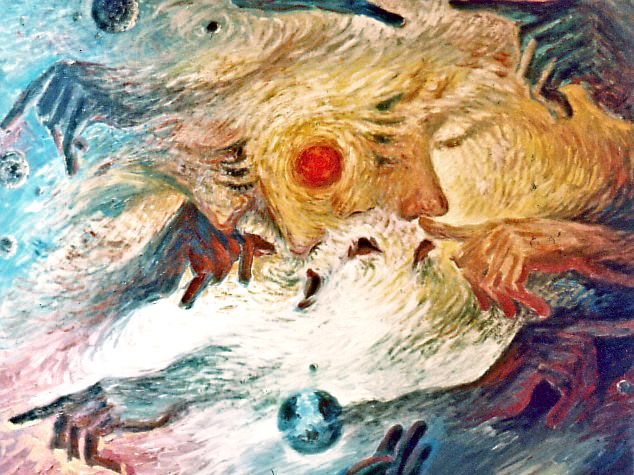
(used with permission via Wikimedia Commons)
At the time, I didn’t understand what she meant by “other-worldly,” but now in my mid-60s, I think I do. My mother was teaching me that God is not physical. T.F. Torrance addressed this truth by saying (along with the early church), that “God is not a creature.” By this he meant that God is not part of his creation. He is not enclosed by creation like a planet is enclosed in physical space and time. God who transcends creation, cannot be known in creaturely ways. He can only be known in “godly” ways, and that knowledge comes to us only through his self-revelation, including what he tells us about himself as creator of the “something” that is material reality.
The simple fact is this: apart from God there is no adequate answer to the ultimate philosophical question. All things that exist (other than God himself who is self-existing) come from the creative action of God who brought all things into existence. Furthermore, what God has created is not divine—not an extension or emanation of the divine. God alone is un-created and divine.
How the creation came about is addressed in the historic Christian doctrine of God’s creating out of nothing (creatio ex nihilo). This doctrine contrasts with the idea of creation out of eternal matter that preexisted alongside God (creatio ex materia), or creation out of an extension or emanation from the being of God (creatio ex deo). The Christian doctrine is not saying that something came from nothing—that would be nonsensical. Rather it is saying that creation came from God in a particular way. God did not use eternally preexisting “stuff” to create.
Science is unable to answer the fundamental philosophical question because discovering non-physical reality using the scientific method is a logical impossibility. As noted by the early church theologian Athanasius, things can only be known according to their nature and the scientific method is useful only for discovering physical causes of physical phenomena. Thus when scientists claim that the only things that exist are things discoverable by the scientific method, they are making a philosophical claim—what rightly would be referred to as “scientism.”
Because God who is un-created is not physical, concluding that everything that exists is detectable and thus knowable using the scientific method is wrong. But this fact does not prevent many scientists from making non-scientific assumptions, conveniently confining all existing things and all that is knowable to the limits of what their method is capable of discovering. Those who do so are using the limited results of their empirical methods to argue for what they are assuming philosophically. But no empirical experiment can confirm or disconfirm whether or not non-physical realities, such as un-created things (God), do exist or can be known by other non-scientific means, such as divine revelation. As T. F. Torrance reminds us, how we know (epistemology) does not determine what is (ontology). The reverse also is true: ontology (what is) determines epistemology (how we know).
Atheists and other skeptics frequently belittle the Christian answer to the ultimate philosophical question as an attempt to justify belief in God. Occasionally they try to debunk the Christian doctrine of creatio ex nihilo by challenging Christians to explain the properties of “nothing” (of course, nothing has no physical properties!). One such atheist, Christopher Hitchens, when asked, “What came before the Big Bang?” replied, “I’d love to know!” I think that reply was sincere, though he died not knowing the answer to his question (I imagine he knows the answer now!).
Atheist Victor Stenger defined nothing as a simple state without mass, energy, space, time, spin, bosons and fermions. He concluded that this state of nothing is an unstable system. But the question remains—How did we get from nothing to this unstable system called nothing? The question itself raises problems because it does not make rational sense. Nothing cannot be unstable since it comprises and encompasses not anything. There is nothing to be unstable in a state of nothing. I can’t refrain from chuckling as I hear such statements; but then my chuckling turns into sadness for those who spend their lives trying to deny the existence of God through such foolish reasoning, and for those who fall for such foolish reasoning.
In his book, The Fallacy of Fine-Tuning: Why the Universe is Not Designed for Us, Stenger belittles as myth the idea that the universe is fine-tuned. However, other scientists disagree. [1] Stephen Hawking (also an atheist) wrote this in his book, A Brief History of Time:
The laws of science, as we know them at present, contain many fundamental numbers, like the size of the electric charge of the electron and the ratio of the masses of the proton and the electron…. The remarkable fact is that the values of these numbers seem to have been very finely adjusted to make possible the development of life.
The evidence for fine-tuning raises the question, “What caused it?” Though some would answer “chance,” mathematician and astronomer Fred Hoyle noted in his book, Intelligent Universe that, “The chance of obtaining even a single functioning protein by chance combination of amino acids” can be compared to “a star system full of blind men solving Rubik’s Cube simultaneously.” This amazing statement came from a humanist who believed the universe always existed (without a creator) and has been constantly fine-tuning itself. Like other humanists and atheists, Hoyle resists the idea that the universe had a beginning because that would point to some sort of “beginner.” Hoyle mocked the idea of creation from nothing, by coining the term “the big bang.” Ironically, that term is now used for a mainstream theory explaining the origin of the universe.
Not all scientists mock the idea that fine-tuning points to a creator. Physicist John Polkinghorne, a Christian, wrote this: “Anthropic fine-tuning is too remarkable to be dismissed as just a happy accident.” While the empirical evidence of the fine-tuning of the universe may not scientifically prove God’s existence, it surely points to the presence of God’s fingerprints all over the cosmos. Some scientists, despite being atheists, in honestly seeking truth, have found God. A great read on that topic is the book, God’s Undertaker: Has Science Buried God? by John C. Lennox, professor of mathematics at Oxford.
It’s important to realize that our calling is not to compete or argue with atheists, but to trust God to work through mathematics, science, astronomy, and even cosmology to prompt them to seek him and find him in his self-revelation, which culminates in Jesus Christ. As Scripture indicates (Luke 10:22) and early church theologians stated, “Only God knows God; only God reveals God.”
Why do we believe in creatio ex nihilo? Because we believe in a God who is generative in his own Triune being. As Jesus teaches and as the New Testament bears witness, the Son is not created or made, but is eternally begotten of the Father in the Spirit. Why is there something rather than nothing? Because God is love and God is relationship among the triune Persons. The Father created through the Son in the Spirit in order to be in a living relationship of holy fellowship with his creation. Creation as well as redemption are acts of the Triune God that reflect or mirror in a limited (created) way the un-created dynamic inner life of the Trinity, which leads to the generation and regeneration of all created life. This life is a gift of grace in which we share for eternity through Jesus Christ.
Loving how science and theology fit together hand-in-glove,
Joseph Tkach
[1] Australian astrophysicist Luke Barnes refutes Stengler’s atheistic reasoning in a post on the Is There a God blog at www.is-there-a-god.info/blog/clues/the-fine-tuning-of-the-universe-stenger-vs-barnes/.
