Fifty years ago, U.S. President Lyndon Johnson announced his War on Poverty: “Our aim is not only to relieve the symptoms of poverty, but to cure it and, above all, to prevent it.” His goal was not to give a hand-out but a hand-up to help people move out of poverty. Now 50 years, multiple government programs and trillions of dollars later, 47 million people are dependent on government for food stamps—13 million more than just six and one-half years ago. A government report gave this assessment:
Rather than provide a road map out of poverty, Washington has created a complex web of programs that often are difficult to navigate. Some programs provide critical aid to families in need. Others discourage families from getting ahead. And for many of these programs, we just don’t know. There’s little evidence either way.
Such ironies abound in our world. Here are two more:
Though the U.S. Federal government has reached record spending levels on education, Standard Achievement Test scores are in serious decline.
Though the U.S. news media was all a-twitter about a big-game hunter who paid for a license and permit to hunt and kill a lion in Africa, the same media essentially ignored the tragic and callous talk from doctors filmed talking about selling infant body parts harvested from aborted fetuses.
Ironies like these reflect the reality that we live in a fallen world. In Genesis we are told that Adam and Eve decided to direct their own steps rather than listen to God. All humanity followed suit, choosing for themselves what is good and what is evil, making their own paths accordingly. The results we now experience were prophesied by Isaiah:
Woe to those who call evil good and good evil, who put darkness for light and light for darkness, who put bitter for sweet and sweet for bitter (Isaiah 5:20).
Apart from God, humanity loses its ability to accurately distinguish between good and evil. Adolph Hitler, Joseph Stalin, Mao Zedong and Pol Pot are notorious examples. As noted by French philosopher Simone Weil in her book Gravity and Grace, “Evil when we are in its power is not felt as evil but as a necessity, or even a duty.” People engaged in evil often convince themselves they are doing what is good. We see this in our day in the high percentage of pregnancies terminated by abortion—it’s a shocking irony that people will mobilize against killing animals but not against the killing of unborn humans.
When we lack awareness of the real God, our focus easily collapses on the self, yielding self-preservation, self-promotion and self-absorption. Apart from God we do what feels good to us—what seems “right” in our own eyes (Judges 17:6 ESV). This is a great irony, because we were never meant to live without God. We were created to be in relationship with him, though, sadly, that relationship was broken by sin. But God created us with a plan in place to deal with sin and restore that relationship. That plan, of course, is Jesus, and Jesus teaches us to live in this broken world with lives surrendered to the sovereign God of holy love. He taught us that no matter how many perplexing ironies we encounter, we can be comforted knowing the ultimate outcome—Christ will return and restore things as they were created to be.
We look forward to that time when all will be set right (Ephesians 1:10; Colossians 1:20) in a renewed heaven and earth where every tear is wiped away (Revelation 21:4). God has not allowed anything that he can’t and won’t in the end redeem (Romans 8:17-25). Indeed, evil has no future (Ephesians 1:21-22; Colossians 2:15). But we don’t have to wait until the final consummation to benefit here and now from God’s promises. Despite the often depressing ironies of the present time, and the certainty that one day we will die, we know that God has invested in us and will never abandon the work he has begun in us. Eternal life is knowing this ever-faithful God who is always with us, and this knowing, this salvation, is an eternal relationship. The apostle Paul instructed us to encourage each other with the hope that comes with this knowledge:
Brothers and sisters, we do not want you to be uninformed about those who sleep in death, so that you do not grieve like the rest of mankind, who have no hope. For we believe that Jesus died and rose again, and so we believe that God will bring with Jesus those who have fallen asleep in him. According to the Lord’s word, we tell you that we who are still alive, who are left until the coming of the Lord, will certainly not precede those who have fallen asleep. For the Lord himself will come down from heaven, with a loud command, with the voice of the archangel and with the trumpet call of God, and the dead in Christ will rise first. After that, we who are still alive and are left will be caught up together with them in the clouds to meet the Lord in the air. And so we will be with the Lord forever. Therefore encourage one another with these words (1 Thessalonians 4:13-17).
Filled with hope by the good and faithful Word of God, Joseph Tkach
We were saddened to learn of the recent death of long-time GCI elder Frederick Myiles Wilson, 93. He passed away peacefully at his home in Peru, Indiana on October 29. Survivors include James Wilson (Chicago), Carl Wilson (Pasadena), Frederick Wilson, Jr. (Peru, Indiana), Herbert Wilson (Bethany, Connecticut) and Marvin Wilson (West Haven, Connecticut). He was preceded in death by his wife Wilma Louise Wilson and son Raymond A. Wilson.
Cards can be sent to:
Carl L. Wilson 259 N. Chester Ave # 1 Pasadena, CA 91106-1873
or
Mr. & Mrs Marvin E. Wilson 20 Andrews Street West Haven, CT 06516-1902
GCI offers high-quality online courses in theology and biblical studies through two educational institutions that are associated with the denomination: Grace Communion Seminary (GCS) and Ambassador College of Christian Ministry (ACCM).
GCS offers two masters degree programs that are accredited in the United States. To learn more, click here.
ACCM offers courses leading to a diploma in Christian Ministry. To learn more, click here.
This update is from Emmanuel Okai, GCI pastor in Ghana, Africa.
Since 2001, GCI-Ghana has been running educational institutions as a way to serve the communities in which we operate. Our philosophy has been to provide the best spiritual, intellectual and social environment for children in our church areas.
Currently we are operating two schools. The first, founded in 2001 in our church hall is known as Kutunse Ambassador International School (see pictures below). It now has classrooms and a computer lab with 14 personal computers.
There are 14 teachers who assist in running the school which serves pre-school, elementary and junior high aged children. Six groups have graduated from the school and some of the pioneer students are about to complete college degrees. The second school, located near Kumasi, the second largest city in Ghana, is known as GCI Basic School. It currently has an enrollment of 60 pupils ranging from pre-school to fourth grade.
Here is part 8, which concludes an 8-part essay by Dr. Gary Deddo titled “The Christian life and our participation in Christ’s continuing ministry.” To read other parts, click on a number: 1, 2, 3, 4, 5, 6, 7. For all 8 parts combined in one article, click here.
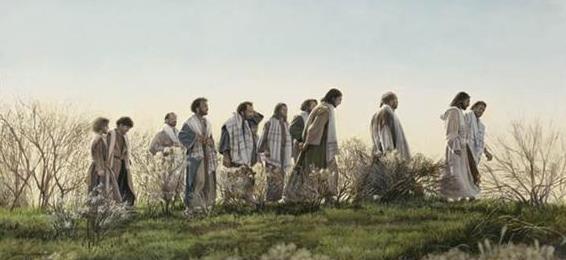
Without Purse or Script by Liz Lemon Swindle (used with permission)
Recap of part 7
In part 7 of this series we saw how the indicatives of God’s grace always provide the foundations and motivation for our obedience to the imperatives (commands) of God’s grace. We saw how this means we need to make sure our understanding of God’s grace fits this pervasive biblical framework. In this concluding issue in this series we will continue to unfold what the grace of our union with Christ looks like in relationship to him. That grace is not a “sloppy agape” where anything and everything goes. God has far more in store for us than that. We conclude by noting that in our gracious union with Christ we live by faith, hope and love.
The grace of God’s “no” to our “no”
God is eternally and implacably opposed to sin, whether in the world or in us. In his divine providence, sin and evil have no future. God would not be gracious if he were not committed and able to bring to an end all sin and in the end make things right. God has said “yes” to us in Jesus Christ. When we say “no” to God and his grace to unite us and transform us, then God says “no” to our unbelief. He says “no” to the disobedience that comes from our distrust of God and his character as revealed in Jesus Christ and according to Scripture. God is opposed to all that is against us and against his gracious will for us. If God did not say “no” to what is evil, God would not be gracious. If God did not say “no” to our “no,” he would not be gracious. But note this: when God says “no” to our “no” to him, he is not changing his mind or his heart or his purposes towards us. By negating our negation of his grace, he is reaffirming his “yes” to us in Christ. He says, “No, I said yes!”
How strongly does God object to our rejection of him and his love and grace? Just as strongly as his love for us is. For it is because of his love for us that he rejects our rejection. If he did not love, there would be no reason for him to bother in objecting to us. His “no” to our “no” is just as strong as his “yes” to us because it is an expression of his “yes” when it meets up with our “no” to him. God’s love and resistance to us (his wrath) are not opposed to each other. His wrath serves his loving purposes. His wrath is to get us to see the error of our ways and to turn around and receive his grace. His anger serves the same purposes as his love: to bring us into right relationship with him through Christ and by the Spirit.
The grace of God’s judgments
And what about God’s judgment? We know God’s ultimate purposes because we see them revealed in Jesus Christ and hear of them in Scripture. Jesus came into the world because of God’s love. He did not come to condemn the world but to save it (John 3:17). God’s will and heart is that all come to repentance and receive his unconditioned grace—his freely offered forgiveness. He does not wish that any eternally perish. Christ died for all. So whatever we think about God’s judgment it should not contradict or call into question Jesus Christ and his revelation and accomplishment of the will of God. How can we do that?
God’s judgment is his “no” to our “no,” his “no” to our unbelief and disobedience. God’s judgment reinforces his gracious and saving purposes. God recognizes evil and is absolutely opposed to it. It will all be done away with in the end. But God, in his grace, judges our sin in Christ—he exposes it for what it is, shows us the truth about it, sorts things out so that we are released from deceit, even self-deception, so that we repent of it, let go of it, and turn to God to receive his freely given grace and forgiveness. God will use whatever means (judgment) to get us, sooner or later, to recognize our sin and our need for his grace and forgiveness and for him to make right what we have made wrong, sometimes very wrong. God judges unbelief and the sin and evil that comes from it—but he judges it because he is loving and gracious. God would not be loving and gracious if he did not sort out what is evil, what needs forgiveness and restoration and do all that he can to turn around and offer up to judgment the sin and evil we have done, or that others have done to us or to others.
But note this: God’s judgment is not the same as condemnation. Judgment is to prevent us from being condemned! God judges because he loves—judgment is God’s resistance and “no” to our sin, even to the sin in us, so that we turn around (repent, confess) and receive his grace and the power to resist temptation and evil. God’s judgment is gracious. His aim is to rescue and deliver us from evil, so that we might be saved and the sin and evil be condemned. God’s purpose is not that anyone eternally perish, but that all sin, evil and unbelief be eradicated, condemned to oblivion. Only God can separate us from our sin without undoing us—but that’s what he’s provided for in Jesus Christ. Jesus Christ dies in our place as God does away with our sin and evil. But Jesus Christ is raised and ascends to eternal life with the Father so that we too may die and be raised with him into new life delivered from all sin and evil. Anything less would mean that God is not gracious. Only those who somehow might manage to reject God’s judgment will face the prospect of being condemned with their sinfulness.
Scripture and its warnings, including the teaching of Jesus, leave open the possibility that some might face condemnation. It’s presented as a real possibility. But that is not because condemnation is God’s purpose and heart and mind towards any of his creatures—those created in his image, created in, through, and to (as an inheritance) Christ. No one has to face condemnation. But if anyone does, it will be because they somehow have come to a place where they reject God’s judgment and absolutely refuse grace, refuse his forgiveness, refuse to receive and live out their life of union and communion with Christ. That is, they somehow finally reject and deny the reality of who God is, who they are, and what he has done for them in Christ. They will not be condemned because of some kind of arbitrary limit to God’s grace, but because of their final and absolute repudiation and hatred of God and his grace, mercy, love and goodness. The reality is that God’s gracious judgment in Jesus Christ in our place and on our behalf is what God does to prevent anyone from experiencing final condemnation.
God’s gracious work of sharing in Christ’s sanctification for us
For those who are receiving God’s grace, the sanctifying work of Christ brought to completion in us by the Spirit’s glorification will leave no trace of sin in us. It will, one day, all be done away with, and that’s a very good thing! Think for a moment: what would it be like in heaven if it were full of people for whom God had made a few little exceptions here and there? Wouldn’t it be fairly much like the condition we find ourselves in today? The only difference is that we’d be in that condition of injustice eternally! Where would be the grace in that? Grace is God’s forbearance, God’s patience, God’s long-suffering. But in the end there will be no exceptions for sin. Evil has no future.
God accepts us where we are unconditionally, in order to take us where he’s going, just as unconditionally. No exceptions! Grace means that God is for us and will not give up on us, no matter how long it takes or how far we have to go, or how many times we fall. God would be less than gracious if he only met us where we are and then left us there! He’ll pick us up because our whole salvation is complete for us in Christ and we belong to him. United to Christ, all that is his is ours. So Paul tells us that Jesus Christ is our wisdom (about God) our righteousness, and he is our sanctification (1 Corinthians 1:30 ESV). By his indwelling Holy Spirit, we are meant to share even in his perfectly sanctified humanity.
What God in Christ has done for us, the Spirit works out in us. So Paul can say: “I live, yet not I, but Christ in me” (Galatians 2:20). We do not work up our own knowledge of God, our own righteousness, our own sanctification. But we share by the Spirit in what is his! This is all of what we receive when we receive him who gave himself for us (Galatians 1:4; Ephesians 5:2; Titus 2:14).
Grace is God’s faithfulness to see us through to his perfect end, even if we sometimes resist or are ungrateful, or only want his blessings because we prefer it to hell! The gracious love of God is implacably committed to perfecting us with Christ’s own glorified humanity. True love longs for the perfection of the beloved.
Can we preach too much of this kind of grace? No! We preach the inexorable love of God, who will not give up on us and has pledged himself to see us to the glorious end of being his children through Jesus Christ. Isn’t this the way to lead people to a faith, hope and love that trusts and believes that “He who began a good work in you will bring it to completion” (Philippians 1:6 ESV)? We have a hope that knows God desires our sanctification, and believes as Paul tells us that, “He who calls you is faithful; he will surely do it” (1 Thessalonians 5:24 ESV). Can we believe this promise too much? Can we count on God too much to provide us with even our sanctification in Christ (1 Corinthians 1:30 ESV)? The answer is no! God is abundantly gracious because he makes no exceptions. On that we can rely.
Conclusion: the obedience of faith, hope and love
The Christian life must be moved by faith, hope and love for God’s Word spoken and living—a Word that presents a God who out of his own graciousness promises to be faithful and to give us an inheritance as his children united to Christ, who invites unswerving confidence in Christ’s continuing work of ministry and the power and joy to enable us to participate in it. All our endeavors built on this foundation will reflect in word and deed the very character of God and exude a joyful trust in his continuing work.
Putting our trust in ourselves, our programs, commitments, convictions, techniques, skills, training or our sophistication and formulas, no matter how ideal, morally ambitious, or spiritually sincere, can only lead to lives that indicate a God who wants slaves not children, a God who depends upon us and who cannot be more faithful than we are, a God who begins with grace but who somehow ends with conditional blessings. The good news is that this is not the God of the Bible, nor the God we worship today. Rather, God has united himself with us, and us with himself, so that all that we think or do, we do as his children, participating with him in all that he is doing in our world now through the continuing ministry of Christ by the power of the Spirit.
The Christian life is nothing but the gracious gift of daily thanksgiving for our real union with Christ, sharing in his glorified humanity and participating by faith in his faithful and continuing ministry to us and all those around us. On this we may surely build our lives in Christ’s name and live to the praise of his glory!
Here is an update from GCI mission developer Rod Matthews concerning GCI’s congregations in the South Pacific nation of Vanuatu.
My wife and I recently flew with Rex Morgan to Vanuatu to visit our congregation in Naveli during their annual family conference. We were met at the airport by Vanuatu’s local pastors, William Davies and Billy Taren (pictured at right with Rex). Together we traveled to Naveli, stopping along the way at village stores to buy supplies. Because the country is in the depths of a drought few fruit and vegetables are available. We bought some canned fish. When we pulled into our church grounds in Naveli I saw that they were beautifully kept, an uplifting reflection of the God we worship.
Their meeting hall accommodated the more than 60 people who attended the services held each day, which were introduced by the children singing and hymns in French and English. The rest of the service was in Bislama, the local version of Pidgin English, with translations by William Davies for the English language messages from Rex and me. I introduced them to their Melanesian brothers and sisters in the Solomon Islands and Papua New Guinea. I wished there had been electricity and the equipment to show pictures. God places us in the Body as it pleases him, and his pleasure is seen in the people of this congregation—remote but a vital part of a globe-girdling entity. We talked about how Jesus is the focus of our life and work, of how he came to reveal the Father, of how his presence in us through the Holy Spirit means we will reflect his characteristics such as humility and service regardless of where we live, of how he embraces our humanity through the events of his life, and the special significance of his resurrection to us and all humanity.
On the day before we left, we drove a few miles along a narrow rough track to a pool in a barely running stream coming down from the mountains to baptize two young people—Dao and Maria. The day was hot and the water was cool. In this most idyllic location, they made a public acknowledgement of their salvation in Christ, and we all rejoiced with them.
As a fellowship, we can thank God for the faithfulness of the local people, ably led by local pastor Billy Taren, with the coordination and dedicated, long-time support of elder William Davies who lives on the northern island of Santo and who travels to the church once every 2-3 months. Special thanks also goes to Rex Morgan who, in his love for the people there, has traveled to Vanuatu at least once a year for 37 years to provide pastoral guidance and encouragement and to keep strong their link with our church in New Zealand. In the words of Paul in Romans 15:33, we say to our brothers and sisters in Christ in Vanuatu in their native language, “God yu we i stamba blong pis blong yumi, hem bambae i stap wetem yufala evriwan” (which in English is “The God of peace be with you all”).
We were saddened to learn of the recent death of Beverly Snuffer, mother of Linda Rex who pastors two GCI congregations in Tennessee. Here are excerpts from Beverly’s obituary:
Linda (at right) with her mother
Beverly I. Snuffer, 82, died at the home of her daughter and granddaughter. She was born in 1933 and married Garland W. Snuffer in 1957. Garland worked for many years in the radio production department of Worldwide Church of God. He died in 2008. Beverly spent many of her married years in California and in later years, after Gar’s retirement, in rural southeast Iowa living near her daughter. After Gar’s death, Beverly moved to Texas for a time where her younger son lived and most recently she lived with her daughter in Murfreesboro, Tennessee. Beverly is survived by her sons Garland and Eric Snuffer, and her daughter Linda (Snuffer) Rex.
Cards may be sent to:
Linda Rex 6627 Longview Drive Murfreesboro, TN 37129-8263
We were saddened to learn of the recent death of Bettie Broadnax, wife of Earl Broadnax and mother of Jeffrey Broadnax, pastor of two GCI congregations in Ohio. Here is a note from Jeffrey:
Bettie Broadnax
My first love, Bettie Broadnax, transitioned from being one who can talk to me to being one who now will speak from within me. Thank you Father in Heaven for giving my siblings and me this gem of a woman to love us. I miss you already Mom. ~your Baby Boy
Cards may be sent to Earl and Jeffrey at the addresses below:
Earl Broadnax 1739 Northcutt St Cincinnati, OH 45237
Jeffrey Broadnax 1211 Deerpath Court Grove City, OH 43123-8750
In August, a new cohort entered the GCI Intern Program (for details, click here). Over the next few weeks we’ll introduce you to some of these new interns. This week we want you to meet Jaron Sanders.
Following graduation from Bethune Cookman University in Florida, Jaron returned to his GCI home congregation in Sacramento, California, where he now is interning with Lead Pastor Mike Swagerty (pictured with Jaron at right). Here is Jaron’s testimony:
Though it took me a while to discover, I came to understand that, at the most basic level, our purpose as humans is to glorify God. It was such a relief to discover this—it freed me from beating myself over the head with “What am I supposed to do?” The answer is that I am supposed to trust and follow God—to walk in a manner pleasing to him. The details will come!
In college I studied mass communications with the intent of becoming a broadcast journalist, but it did not fulfill me. At the time, I was throwing myself into extra-curricular ministry activities, and found that this is what makes my heart beat! Eventually I realized that I was called to full-time ministry. I love seeing people experience the loving presence of Jesus.
Jaron is receiving free housing from Tim and Linda Wakeley (pictured with Jaron below), a generous couple in the Sacramento congregation.
Welcome to the GCI Intern Program, Jaron. Our prayers are with you. And Mike, Tim, Linda and the Sacramento congregation, thanks for all you are doing to support Jaron at this important time in his life and ministry with Christ.
______________
To learn more about the GCI Intern Program, click here.
Here is part 7 of an 8-part essay by Dr. Gary Deddo titled “The Christian life and our participation in Christ’s continuing ministry.” To read other parts, click on a number: 1, 2, 3, 4, 5, 6, 8. For all 8 parts combined in one article, click here.
Without Purse or Script by Liz Lemon Swindle (used with permission)
Recap of part 6
In part 6 we looked at how we ought to preach, teach and counsel others to participate in their union with Christ. The danger here is that we would highlight the commandments, simply telling people to do things for God because he said so. This leads to misrepresenting the character of God and to legalism, a wrong relationship with God. We always need to bring about the obedience of faith by showing the foundations for any call to obedience. And that foundation is built up from all the indicatives of grace that always form the basis of the obligations of grace. This time we’ll explore more of the antidote to legalism and the real meaning of grace.
Legalism
For every act of desired obedience, we must present and focus on the character of God manifest in Christ that corresponds to that imperative. That is because all obedience that gives glory to God must arise out of faith, hope and love for who God really is, both in himself and towards us. The apostle Paul says both at the beginning and the ending of Romans that his whole ministry is to bring about the “obedience of faith” (Romans 1:5; 16:26). He explains that any obedience that does not proceed from faith is sin (Romans 14:23).
We often think that legalism is the problem of someone who is committed to consistent obedience who needs to be corrected by allowing for their inconsistent obedience! But really, legalism is obedience that does not arise out of faith, hope and love in the character of the gracious Lawgiver. Legalism is obedience without faith. James Torrance often reminded his students of Calvin’s concern to avoid legal repentance (repentance without trust in the gospel of grace), focusing instead on evangelical repentance (repentance in light of the grace and forgiveness of God that is offered to sinners out of God’s sheer goodness, righteousness and mercy).
It is a grave mistake to merely preach the commandments by addressing the will of the Christian and calling for volitional conformity to the standards of God. Concentration on the requirements of God or even the ideals of God may tempt hearers to a faithless obedience. It is even more dangerous to misrepresent the character of God by speaking as if God had two sides to his character, as if God was two-faced or double minded, first offering grace and then switching to a concern for moral and spiritual conformity to his will and threatening the withdrawal of his grace. Preaching this way communicates that although we are first saved by grace, we are really sanctified by works. It says the Christian life may have begun by grace but is essentially lived out in a conditional and contractual relationship with God. Under such guidance many, I think, see their lives under a great impossible burden.
I’ve known of some who wanted to be non-believers again so they could become Christians all over, experiencing afresh the grace of God. But such admonishment, undoubtedly concerned for faithful and consistent lives, obscures the truth and actuality of Christ’s gracious and unconditioned continuing ministry and our union with him. It regards Christ as at a distance, sending us out to do for him what he is unwilling or unable to do himself, becoming somehow dependent upon us. We end up communicating that, at least subsequent to our conversion, God can no longer be more faithful than we are!
Preaching the commandments apart from the promises of the unconditional and unconditioned grace of God is like putting people in a windowless room with the door shut and the lights off and telling them, “On the count of three start enjoying the sunset!” Few have such imaginative powers! But if we could take someone to the top of Sentinel Dome on the 3000-foot-high western-facing ridge of Yosemite Valley, just at sunset, all we would need to do is declare, “Watch!” and their joy would be irrepressible.
So in preaching, only the glory and the character of God can draw out of us a faith that leads to a faithful obedience. Otherwise, our sacrificial endeavors are most often driven not by faith, hope and love, but by guilt, fear and anxiety as we are thrown back upon ourselves and our own five loaves and two fishes while standing in front of 5,000 hungry souls. Only the presentation of the heart and character of God fully revealed in Jesus Christ can bring us to the point of faithful obedience. This is why all our preaching and teaching must take as its staring point the question of who this God is, not the questions of what should we do or how should we do it. However, this is often not the starting point for preaching, teaching and counseling in connection with living the Christian life. I think that contributes to the weaknesses of our churches and burnout in the Christian life and ministry. It will also erode any of the new initiatives intended to renew the church mentioned at the beginning of this essay.
Too much grace?
There is one further concern that I have seen James Torrance respond to on numerous occasions. Some professional theologians, pastors and laypersons fear that we can preach too much grace. They would counsel that we have to somehow counterbalance grace so as to prevent people from taking advantage of grace. But what are we going to preach and teach to substitute for and counterbalance what is perceived as over-generous grace? Will we offer some new means for us to condition God into being gracious? Or preach a stingy God or a God dependent on us? A God who cannot be more faithful than we are? If so, we will end up misrepresenting the true God of the Bible for all our good intentions to get people “doing things” for God.
Grace means no exceptions
The problem with such a project is that it assumes a very inaccurate view of grace. If it were somehow possible to preach too much grace, then it isn’t really grace that’s being preached! I think that our understanding of grace is unfortunately often quite insufficient. This is in large part due to the general, cultural understanding of grace. Grace is often taken to mean making an exception to the rule. So we have “grace periods,” and we say someone is gracious when they let us off the hook of responsibility. The grace of forgiveness can be taken to mean diminishing the seriousness of sin or pretending it never happened. But we cannot take our cues from these misguided understandings.
Following in the pathway of Torrance’s understanding, I contend that real grace makes absolutely no exceptions. If it did make exceptions, it would not be gracious! Grace provides everything needed, and by the Spirit transforms our hearts and minds to be more and more like Christ’s. Grace accepts us where we are as we repent and takes us to where he is going so we may be with him forever. Grace is God’s commitment to get us, in the end, where we belong, even at God’s own cost.
As James Torrance used to point out, the unconditional grace of God means the unconditional obligations of grace. But these are the obligations of being in a gracious relationship with God through Christ, not the conditions to get God to be gracious towards us. Presuming upon grace (as if it were some kind of commodity that God doles out) is not the same as living in and receiving grace. Living in fellowship and communion with God, in union with Christ, means going where he goes and doing what he’s doing, not going where he does not go and doing the kinds of things he is not doing or involved in. The obligations of grace are spelled out as imperatives, as commands, in the New Testament. Living according to these commands is the way we continue to receive daily God’s grace.
Saying we have God’s grace and thinking there are no obligations at all, is saying there is grace but I don’t have to receive grace. Disobedience is not receiving grace and not living in our fellowship and communion with Christ. Disobedience presumes upon grace, and so amounts to actually rejecting grace!


 Fifty years ago, U.S. President Lyndon Johnson announced his War on Poverty: “Our aim is not only to relieve the symptoms of poverty, but to cure it and, above all, to prevent it.” His goal was not to give a hand-out but a hand-up to help people move out of poverty. Now 50 years, multiple government programs and trillions of dollars later, 47 million people are dependent on government for food stamps—13 million more than just six and one-half years ago. A government report gave this assessment: